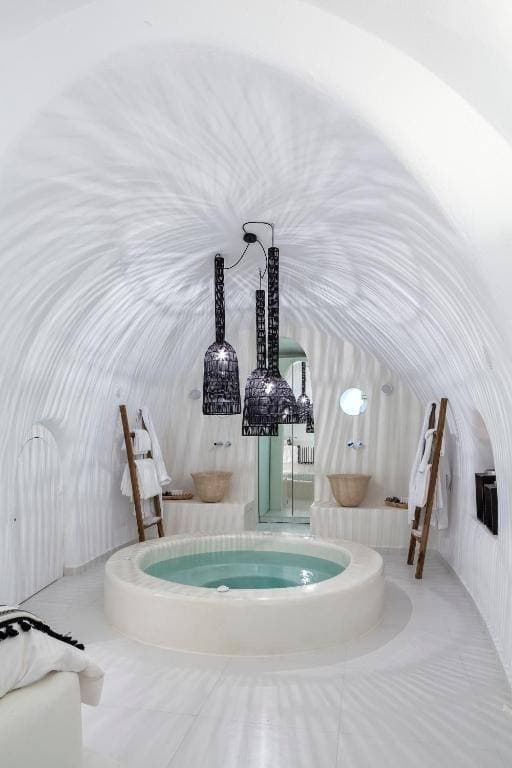
50m²
Σουίτα Μήνα του Μέλιτος
Υπόσκαφη σουίτα με βεράντα προς την καλντέρα, για ζευγάρια και ξεχωριστά ταξίδια.
Δείτε το δωμάτιο
Where to Stay
By Fanis Kafouros, Owner since 2006 · Published · Updated
Most visitors to Santorini spend weeks researching which village to stay in, comparing Oia's blue domes against Imerovigli's quiet terraces, reading the same recycled lists. Then they arrive in Fira, the island's capital and transportation hub, and realize they should've started here all along.
Short answer: Fira is the best base for most Santorini visitors. It's the island's capital and transport hub: the central bus station, the cable car down to the Old Port and most of the island's restaurants and bars are within walking distance. It sits on the same caldera as Oia, with the same sunset, at lower prices. The caldera path north to Firostefani and Imerovigli starts in town.
Visitors spend weeks agonizing over which Santorini village to stay in. They compare Oia's blue domes against Imerovigli's quiet terraces, read the same recycled lists on ten different blogs. Then they land. Take the bus to Fira. Walk around for twenty minutes. And realize this is where they should've been all along.
This guide is written from Fira. Not from a cruise ship that docked for four hours and left. We live here, we work here, and what follows is what we tell friends when they ask: what's Fira actually like, where should I eat, and is it really the best base for exploring Santorini? If you're still weighing your options, start with our complete guide to where to stay in Santorini, it compares every area without pulling punches.
The long version follows.
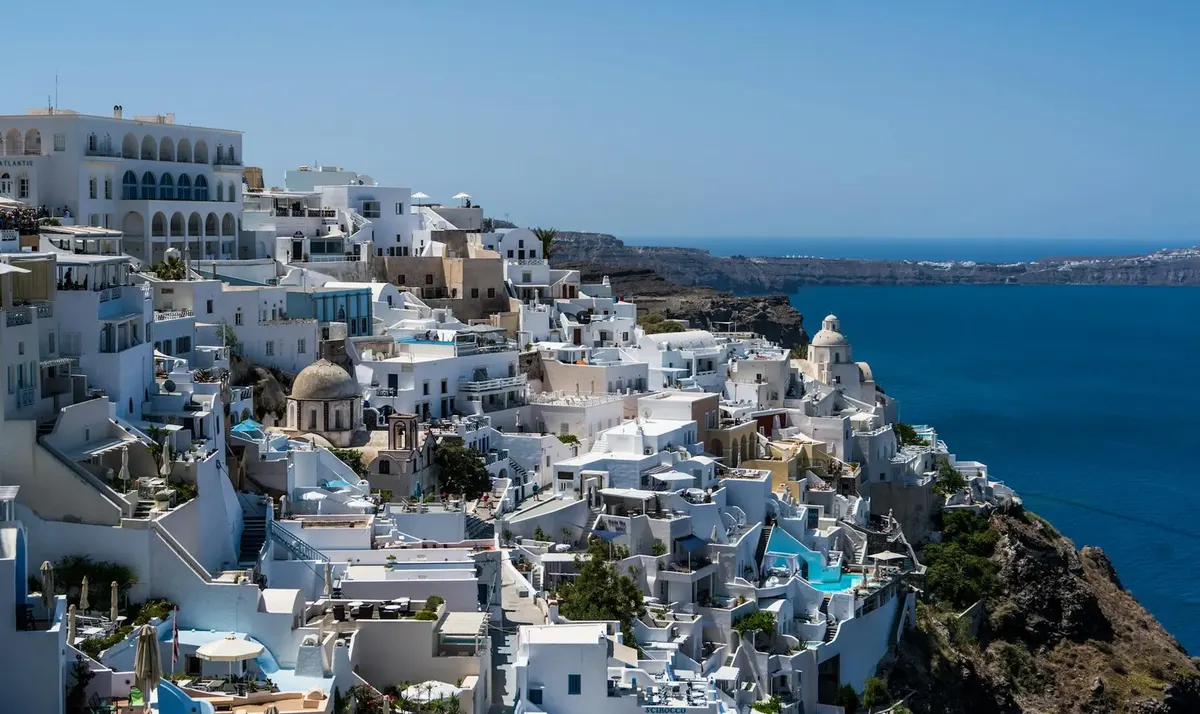
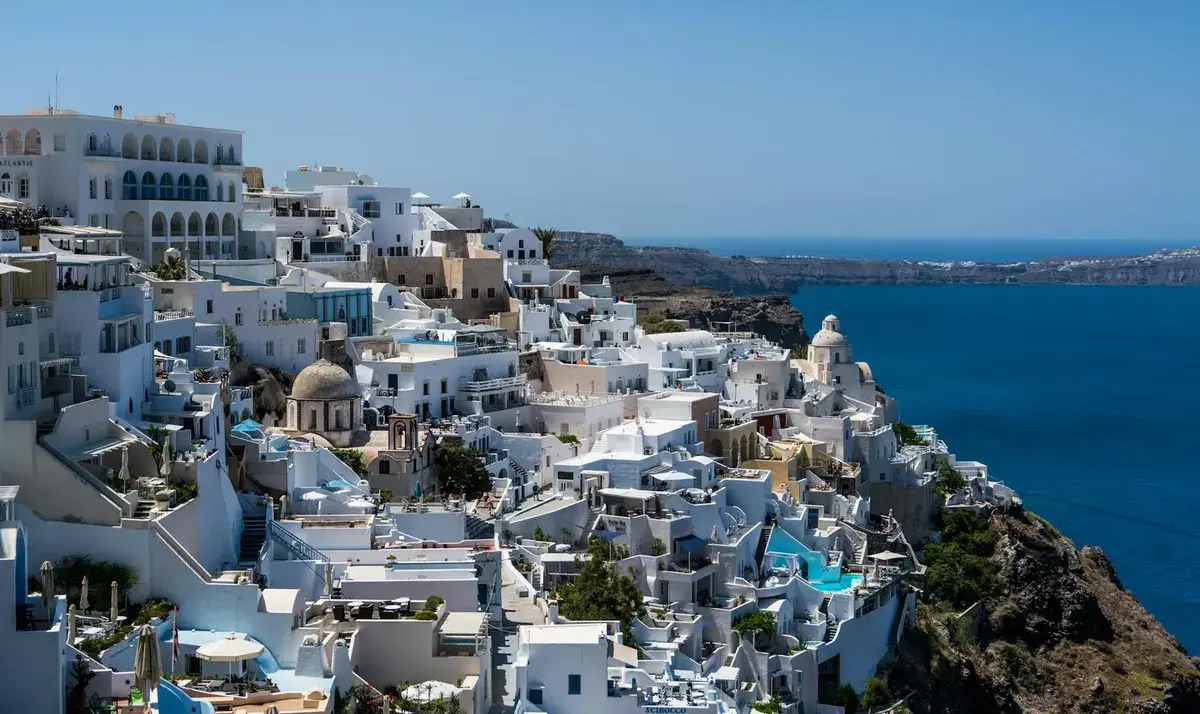
Fira sits along the western rim of the caldera, the massive volcanic crater that defines Santorini, with whitewashed buildings cascading down the cliff face toward the Aegean 300 meters below. Two personalities in one town. On the caldera edge: narrow pathways winding between cave-style hotels, quiet terraces, and churches with views in every direction. Two minutes inland: shops, restaurants, and the buzz of a real working town.
That split personality is what separates Fira from everywhere else on the island. Oia, Imerovigli, Firostefani, beautiful, all of them. But they're caldera-edge settlements with limited infrastructure beyond hotels and a handful of restaurants. (For a detailed breakdown, see our Imerovigli vs Firostefani vs Fira comparison.) Fira is a town. People live here year-round. There's a bus station, a hospital, banks, pharmacies, a post office. The butcher opens at seven. The bakeries sell koulouri to locals heading to work while tourists are still asleep.
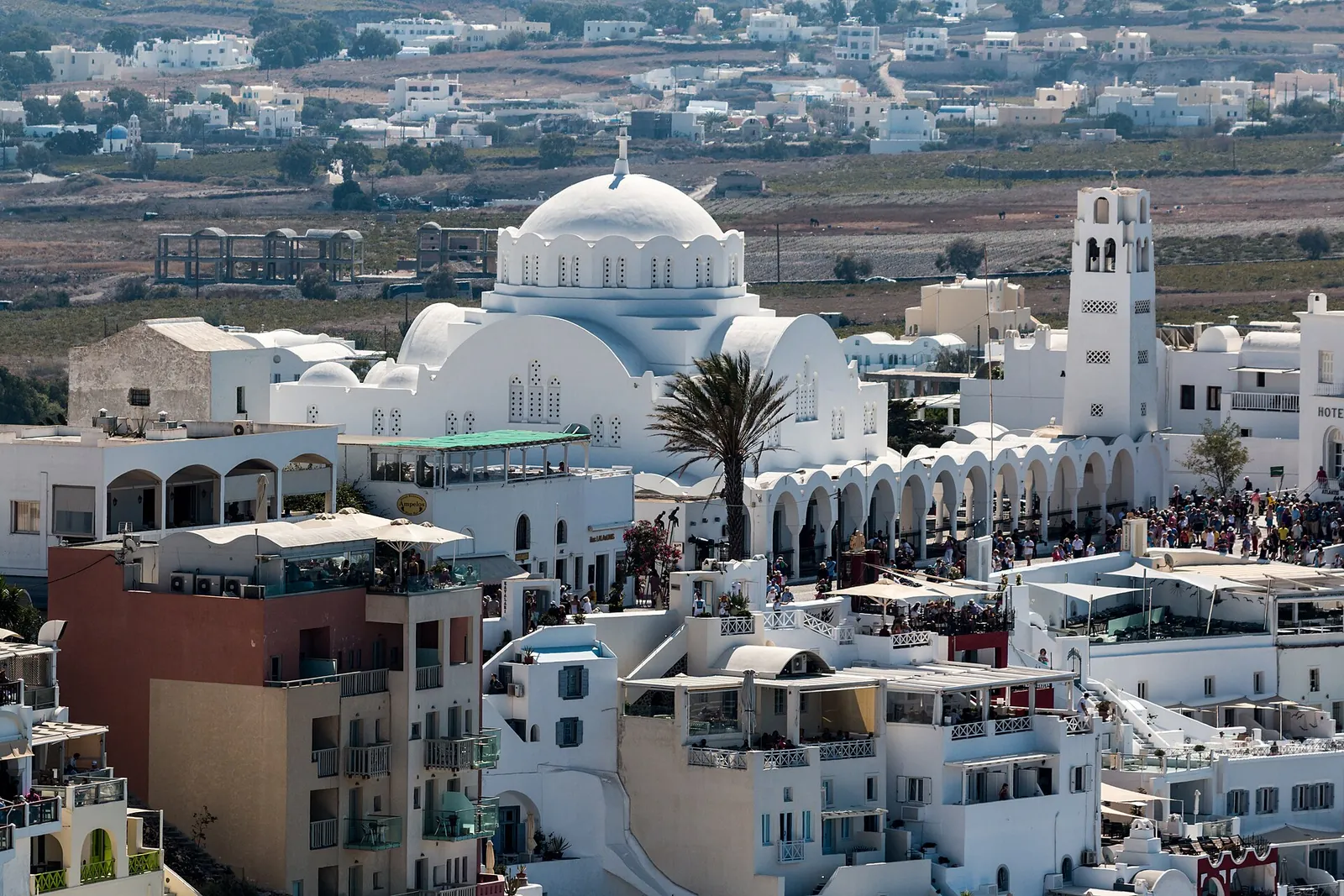 Photo: Dietmar Rabich, CC BY-SA 4.0, via Wikimedia Commons
You can eat at a different restaurant every night for a week and not come close to trying everything. You can walk from a quiet caldera-view terrace to a cocktail bar in three minutes flat. And every evening, you stroll back to your cliffside hotel and watch the same sunset that Oia charges twice the price for.
Detailed head-to-head comparison in our Fira vs. Oia guide.
Fira gives you a central location, easy transport, the widest choice of restaurants, and caldera views at lower prices.
Every KTEL bus route on Santorini starts and ends at Fira's central bus station near Taxi Square:
Stay anywhere else and you probably need to come through Fira first. Oia is stuck at the northern tip, 11 kilometers away. Imerovigli has only an hourly bus to Fira. Only Fira puts you at the center of everything.
Taxis are the other reason. Santorini has only around 35 to 40 taxis for the whole island, and in peak summer a 30 to 45 minute wait for one is normal. Having the bus station a five-minute walk from your hotel changes the shape of your days completely. Wake up. Decide you want Perissa beach. On a bus in ten minutes. That spontaneity is just not possible from Oia or Imerovigli.
Fira, Oia, Imerovigli, and Firostefani all face the same volcanic crater, the same sea, the same sunset. The angle shifts slightly. The experience of watching the sun drop into the Aegean beyond the caldera? Identical.
What's not identical is the bill. A caldera-view room in Fira runs EUR 150 to 400 per night in high season. In Oia, the same view starts at EUR 250 and regularly flies past EUR 500. Over four nights, the Oia premium adds EUR 400 to 800 to your trip. For the same sunset.
More dining variety than any other town on Santorini. Fine dining on the caldera edge. Honest tavernas where locals eat. Late-night gyros. Wine bars. Our full picks are in best restaurants in Fira.
Fira's dining ranges from caldera-edge white-tablecloth spots to unpretentious family kitchens. Unlike Oia, you can eat well here without dropping EUR 50 per person every single meal.
Selene is the name locals bring up first for serious fine dining. Modern Greek cuisine with deep roots in indigenous Santorini ingredients, multiple-course tasting menus, and a refined room focused on the food. Book ahead.
Argo has moved from its original caldera-edge location and now operates from a new spot inland. The food remains excellent: Greek-Mediterranean classics, grilled octopus, lamb, fresh fish, with a strong Assyrtiko selection. Worth a dinner that feels special without being stuffy.
Aktaion, in neighbouring Firostefani (a short walk along the caldera path), is one of the older caldera-view restaurants on this stretch. Less flashy. Consistently good. Traditional Greek, generous portions, fair prices.
Naoussa is a family-run taverna a few steps off the main path. No caldera view, but the food is the kind of cooking your grandmother would do if she were Greek: slow-cooked stews, salads with local tomatoes, grilled meats. Locals eat here.
Nikolas has survived on food quality rather than Instagram appeal. Straightforward Greek cooking, fair prices. The moussaka is excellent.
Mama Thira, in Firostefani (a short walk north along the caldera path), does home-style dishes with warm service that makes you want to come back the next night. Try the fava, Santorini's famous yellow split pea puree, made from a variety that only grows in the island's volcanic soil.
Lucky's Souvlakis near the main square. Excellent gyros until late. Under EUR 5 for a wrap. A good late-night stop on the walk home.
For wine, the caldera-edge wine bars along Marinatou pour flights of Santorini Assyrtiko, Nykteri, and Vinsanto with a view. Most charge EUR 12-25 for a 3-wine flight.
More packed into a small area than any other town on the island. Sunset walks along the caldera edge, museums, shopping, and the starting point of Santorini's most famous hike.
The caldera path from Fira stretches north through Firostefani and Imerovigli, eventually reaching Oia, roughly 10 kilometers along the cliff. You don't have to do the whole thing. Fira to Firostefani is about 15 minutes and is worth it even as a casual evening stroll. Continue to Imerovigli and you add about 25 minutes, arriving at Skaros Rock, a rocky headland with ruins of a medieval fortress.
For the full Fira to Oia walk, allow three to four hours. Start early. Midday heat is punishing. Water, sunscreen, proper shoes.
This hike is one of the best things to do in Santorini, and Fira is the natural starting point.
Every visitor wants the sunset. Most assume Oia is the only option, but the sunset looks the same from Fira, same caldera, same sun, same direction, without the shoulder-to-shoulder crowd at Oia's castle ruins. Find a spot on the caldera path. Order a drink at a cliffside bar. Watch from your hotel terrace. Quieter. More personal. Free.
The Museum of Prehistoric Thera, near the bus station, has artifacts from the Akrotiri archaeological site: wall paintings, pottery, and tools from a Minoan settlement buried by volcanic eruption around 1600 BCE. Small but worth your time.
The Archaeological Museum of Thera covers Geometric to Roman periods. The Megaro Gyzi Cultural Centre focuses on more recent island history, photographs from before and after the 1956 earthquake. All three in a single morning.
Main shopping streets: Erithrou Stavrou (Gold Street) and the lanes around the central square. Jewelry shops, galleries, boutiques. Quality varies wildly. For genuine Santorini products, look for volcanic stone jewelry, Assyrtiko wine, fava products, and handmade ceramics.
The commercial streets pack out during cruise ship hours (roughly 10:00 to 16:00 in summer). Shop early morning or evening if you want to breathe.
The cable car drops 220 meters from the caldera rim to the Old Port where cruise tenders dock. Three minutes, EUR 10 each way. Worth it even if you're not arriving by ship, the views of the cliff face from below are a perspective most visitors miss entirely.
The alternative is 588 steps shared with donkeys. Take the cable car. More details in our Santorini cable car guide.
Fira is the only town on Santorini with genuine nightlife. Cocktail bars, wine bars, a handful of clubs that stay open until early morning. Oia has a few quiet bars. Imerovigli and Firostefani have nothing after dark beyond hotel terraces.
Two Brothers Bar, caldera-edge fixture. Open-air, strong cocktails, sunset views. Gets busy. Keeps its character.
Tango Bar draws visitors and locals alike. Cocktails, music that picks up as the night rolls on, terrace seating with caldera views.
Kira Thira Jazz Bar is the most atmospheric spot in Fira. Cave-style interior, live jazz on many evenings. Small. Intimate. Completely different from the louder bars.
Tropical Bar and Enigma Club for the late crowd. If you're expecting Mykonos-level clubbing, recalibrate. Santorini nightlife is more low-key. But Fira has enough variety to fill an evening.
Everything concentrates on and around Erithrou Stavrou street. Most bars are a two-minute walk apart. No other town comes close.
Fira is compact. Everything you need, transportation, banking, medical, shopping, is within walking distance.
Two categories. Caldera-side hotels are carved into the cliff edge with volcano and sea views. Town-side hotels sit back from the caldera in the main town.
Hotels carved into the volcanic cliff, terraces facing the caldera, the volcano, and the sunset. Most are cave-style hotels, whitewashed interiors, curved ceilings, thick walls, that cool atmosphere of traditional Cycladic architecture. Many offer private jacuzzis with views.
This is where the Santorini experience actually lives. Waking up, stepping onto your terrace, the volcano floating in the blue right in front of you. EUR 150 to 400 per night in high season, 30 to 50 percent less than comparable rooms in Oia. You'll find everything from traditional cave suites to modern boutique hotels along this stretch.
And the caldera edge in Fira is surprisingly quiet. Once you step off the main path and onto the cliff, the noise disappears. Most visitors don't expect that.
No caldera views. But EUR 60 to 150 per night, and you're still minutes from everything. A solid choice if you plan to spend most of your time out exploring and would rather spend more on meals and experiences instead.
First trip to Santorini and the caldera experience matters to you? (For most visitors, it should.) Choose caldera-side. The price premium over a town-side hotel is real. But so is the difference in daily experience.
For a shortlist by price and view, see our guide to the best hotels in Fira. If the view from the room matters most, our caldera view hotel guide explains what to check, and our guide to boutique hotels in Santorini compares Fira with the other villages.
Yes, Fira is the best base for most visitors. It's the island's transportation hub with buses to every major destination. Oia in 25 minutes, any beach in 20 to 30 minutes, airport or port in 15 to 25 minutes. Less time commuting, more time actually doing things.
The caldera path walk at sunset and at least one caldera-edge dinner. Add the cable car ride and the Museum of Prehistoric Thera. If you have more time, the full Fira to Oia hike along the caldera rim is one of the best experiences on the island.
Two to three full days covers the town thoroughly. If you're using Fira as your base for the whole trip, which we recommend, plan three to five days total on the island. That gives you time for day trips to Oia, the beaches, wineries, and archaeological sites.
For most first-time visitors, yes. More central, more restaurants, the only real nightlife, and caldera views at 30 to 50 percent lower prices. Oia is more photogenic but geographically isolated and expensive. Full comparison in our Fira vs. Oia guide.
The main shopping streets get busy during cruise ship hours (10:00 to 16:00). But the caldera-side hotels and pathways? Surprisingly quiet. The commercial center absorbs most of the foot traffic. The cliff edge, where the best hotels and terraces sit, feels like a different town entirely. Early mornings and evenings, even the main streets calm down. Outside July and August, Fira is lively but rarely overwhelming.
Every argument for staying elsewhere is really an argument for giving something up. Oia: beautiful but isolated and expensive. Imerovigli: peaceful but limited. Beach towns: affordable but you miss the caldera entirely. Fira doesn't make you choose between views, access, dining, nightlife, and value. You get all of it.
It's also why Fira has been the island's capital for centuries, and why most visitors who stay here once come back.
Aroma Suites is built into the caldera cliff in central Fira. Rooms and suites, cave suites among them, with volcano views from every room, the bus station and Fira's best restaurants within a five-minute walk, and a team that knows the island well enough to help you plan every detail. Book your caldera-view suite.
For a different style under the same local ownership: Uma Ray Suites, also in Fira, offers modern luxury with a pool, and Casa di Terra Villa, inland in Messaria, is a private villa for couples or small groups who want their own space.
Σχεδιάζετε ταξίδι στη Σαντορίνη;
Αποκτήστε τον οδηγό μας
Τοπικές συμβουλές, κρυμμένα σημεία και αποκλειστική έκπτωση απευθείας κράτησης, κατευθείαν στο inbox σας.
Μείνετε μαζί μας
Έξι δωμάτια και μία ιδιωτική βίλα στην καλντέρα, στο κέντρο της Φηράς. Η απευθείας κράτηση περιλαμβάνει κρασί για διαμονή 3+ νυχτών και δωρεάν μεταφορά από το αεροδρόμιο για 4+ νύχτες.
Υπόσκαφη σουίτα με βεράντα προς την καλντέρα, για ζευγάρια και ξεχωριστά ταξίδια.
Δείτε το δωμάτιο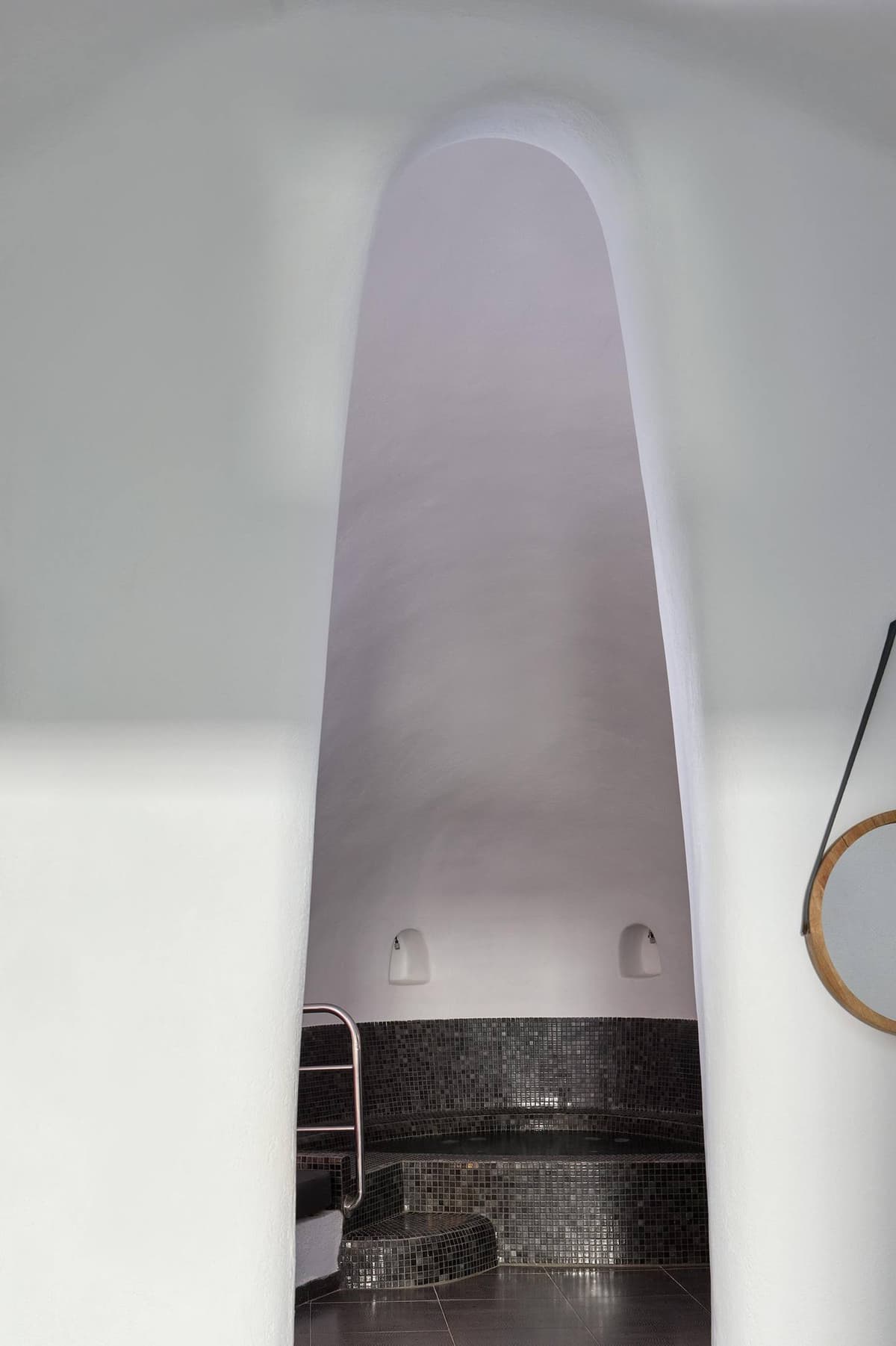
Υπόσκαφη σουίτα 70m² με εσωτερικό θερμαινόμενο τζακούζι και θολωτά ταβάνια.
Δείτε το δωμάτιο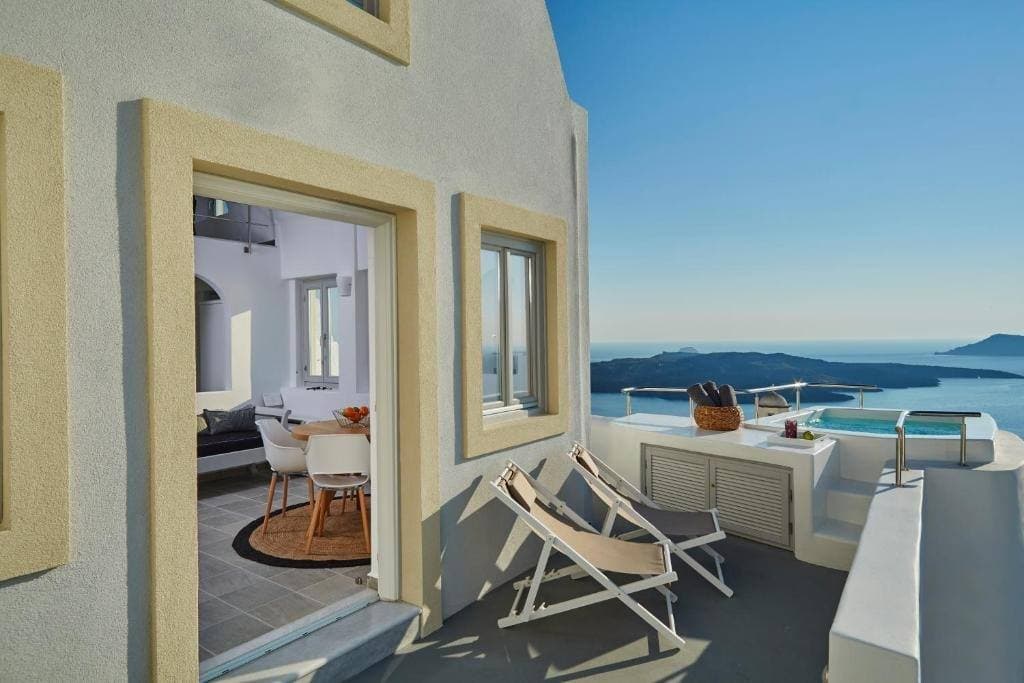
Θερμαινόμενο εξωτερικό τζακούζι στο δικό σας μπαλκόνι, με θέα την καλντέρα και τη δύση.
Δείτε το δωμάτιοYour Stay Awaits
Experience Santorini from a cave suite perched on the caldera edge in Fira.