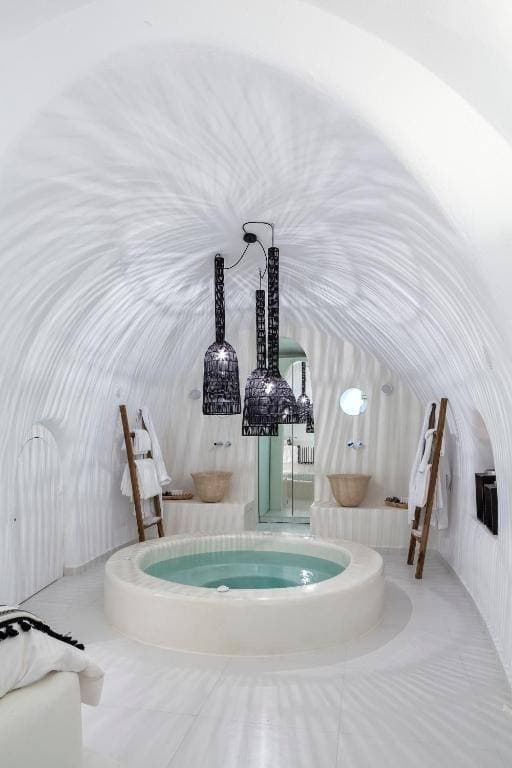
50m²
Honeymoon Suite
Cave suite with caldera-facing veranda, designed for couples and milestone trips.
View room
Where to Stay
By Fanis Kafouros, Owner since 2006 · Published · Updated
Deciding where to stay in Santorini is the single most important choice of your trip. Pick the wrong restaurant and you'll recover by dinner the next night. Visit the wrong beach and you can drive to a better one by afternoon. But where you stay shapes everything.
Short answer: For most first-time visitors, Fira is the best base in Santorini. It sits in the island's centre with the widest transport links, the most restaurants and shops within walking distance, full caldera and sunset views, and better value than Oia. Choose Oia for a quieter, ultra-scenic and pricier honeymoon stay; Imerovigli or Firostefani for calm caldera views; and beach towns like Kamari and Perissa for sand at lower prices. Aroma Suites is a cave hotel in central Fira.
After 20 years hosting guests here, my honest advice is simple: choose your base for how you want to wake up and how far you want to walk to dinner, not for the prettiest thumbnail.
Fanis Kafouros, owner of Aroma Suites, in Fira since 2006
Where you sleep on this island shapes your whole trip.
Pick the wrong restaurant? You'll find a better one tomorrow. Wrong beach? Drive twenty minutes to the next. But your hotel sets the frame for everything, what you see first thing in the morning, whether you walk to dinner or spend forty-five minutes hunting a taxi, how much of Santorini you actually get to experience versus how much time you burn just getting around.
And most visitors get it wrong. They read the same recycled guides, see the same drone photos, book the place with the prettiest thumbnail. Nobody talks about the trade-offs. Every Santorini town has real advantages and real drawbacks, and the gap between a good trip and one you'll remember for years often comes down to understanding those trade-offs before you hand over your credit card.
This guide to where to stay in Santorini comes from people who live here. We'll be honest about every area, including the one where we happen to run a cave hotel. No affiliate links. No sponsored lists. No wishy-washy "choose the best area for your style" fluff. Just walking times, price comparisons, and the kind of specifics that only come from doing this for years.
Still early in the planning? Our complete Santorini travel guide covers when to visit, how to get here, what to do, and where to eat. This page is just about where to lay your head.
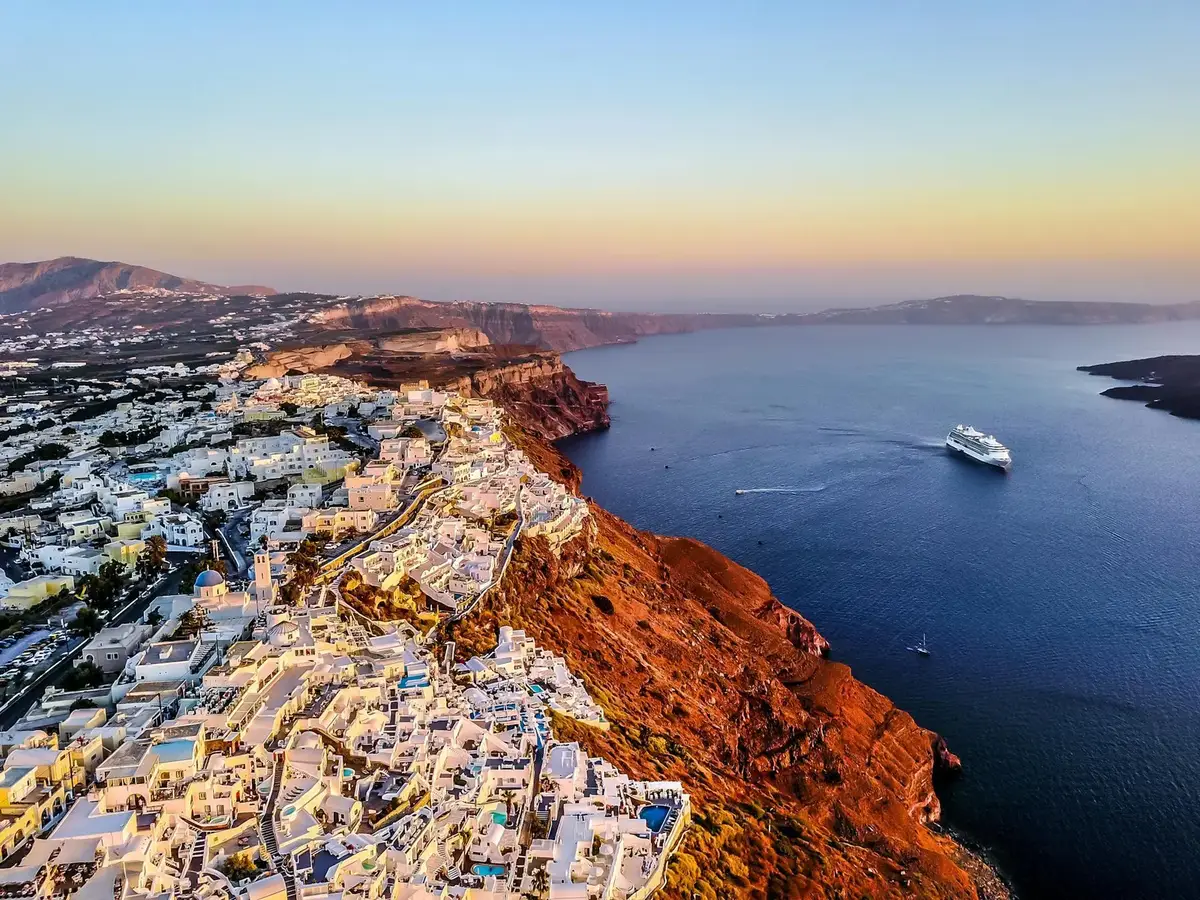
The best area to stay in Santorini for most first-time visitors is Fira. It's the island's capital and transportation hub. caldera views, the widest restaurant selection on the island, and hotel rates well below Oia's (about EUR 120-400 a night against EUR 300-1,000+, according to Santorini Secrets' 2026 area guide). Below is an honest comparison of the main places to stay, the four caldera towns plus the Kamari and Perissa beach towns, the same thing we tell friends when they call asking where to book. For quieter inland villages like Pyrgos, Megalochori and Emporio, see our Santorini villages guide.
| Fira | Oia | Imerovigli | Firostefani | Kamari / Perissa | |
|---|---|---|---|---|---|
| Caldera views | Yes, sweeping | Yes, iconic | Yes, highest point | Yes, gorgeous | No |
| Walkability | Excellent, everything nearby | Good within village | Limited, small village | Good, 10 min walk to Fira | Good, beachfront promenade |
| Restaurant variety | Best on the island | Limited, expensive | Limited | Limited but growing | Good, casual |
| Nightlife | Yes, bars and lounges | Minimal | None | None | Beach bars |
| Getting around the island | Bus hub, easiest | 25 min bus/drive to Fira | 20 min walk or taxi to Fira | 10 min walk to Fira | 20 min (Kamari) / 30 min (Perissa) bus to Fira |
| Sunset views | Yes, same caldera | Yes, most famous spot | Yes, higher vantage | Yes, beautiful | No |
| Crowd level (summer) | Busy center, quiet cliffside | Crowded | Quiet | Quiet | Moderate |
| Price range (double/night) | EUR 120-400 | EUR 300-1,000+ | EUR 250-900+ | EUR 180-600 | EUR 80-200 (Kamari) / 70-180 (Perissa) |
| Best for | Most visitors, couples, first-timers | Luxury, Instagram, once-in-a-lifetime | Quiet romantic escape | Couples wanting calm + access | Beach lovers, families, lower-cost stays |
Short version: If this is your first time, especially as a couple, Fira wins. More dining, more access, caldera views that are identical to Oia's, and you don't need a car.
Four towns. One cliff. Same sunset.
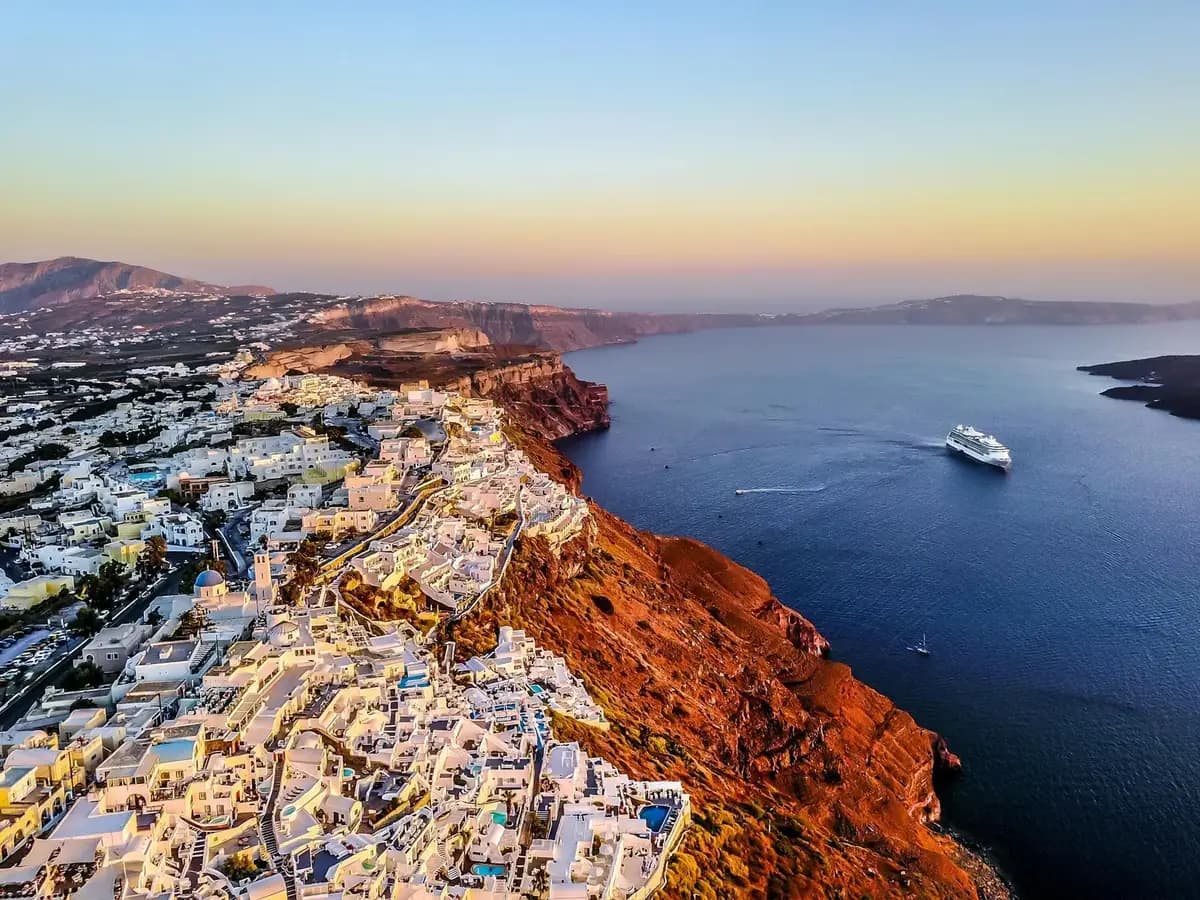
Santorini has four caldera towns: Fira, Firostefani, Imerovigli, and Oia. All four perch along the western cliff edge looking out over the volcanic crater and the Aegean. They're connected by a single walkable path and share the same sunset direction. But each delivers a very different experience in price, dining, access, and atmosphere.
Here's the geology in thirty seconds. About 3,600 years ago, one of the most violent volcanic eruptions in recorded history blew the center of the island into the sea. What was left: a crescent of towering cliffs, roughly 300 meters high, with four villages clinging to the edge. That crescent is the caldera.
A walking path traces the cliff from Fira to Oia, about three to four hours if you do the whole thing, with the volcanic islands, the Aegean, and the cliff face keeping you company the entire way. We cover that walk in detail in our Santorini travel guide.
Why the caldera side matters: You wake up to the volcano, the sea, and a sky that changes color every hour. Hotels here are carved into the cliff or built on its edge, many with private terraces facing straight west. This is the Santorini you came for.
The eastern side, Kamari, Perissa, Perivolos, has beaches, flat terrain, and much lower prices. But no caldera drama. No cliffside architecture. A completely different trip. We'll cover those areas too, because for some travelers they're actually the better pick.
Each caldera town has its own personality. Here's how they compare.
Population: ~2,000 (swells to 10,000+ in summer) Walk to bus station: You're already there Walk to nearest restaurant: 2 minutes Caldera views: Yes, the full sweep from volcano to sunset Price range (double/night): about EUR 120-400, shoulder to high season (Santorini Secrets' 2026 area guide)
Bias disclosure: Aroma Suites is in Fira. Take that into account. But we built our hotel here for the same reasons we recommend it to every guest, and those reasons don't change whether you stay with us or not.
Fira is the island's capital and transportation hub. Every KTEL bus route on Santorini starts and ends at Fira's central station. Oia in 25 minutes. Perissa beach in 30. Kamari in 20. Akrotiri in 20. Airport, port, no transfers needed. Stay anywhere else and getting around the island usually means coming to Fira first.
That sounds like a minor detail until you're actually here. The island has only around 35 to 40 taxis. In peak summer, a 30-45 minute wait is normal. Having the bus station a five-minute walk from your hotel isn't just convenient, it's the difference between a smooth day and a frustrating one. We've watched so many guests staying in Oia tell us they wish they'd known this before booking.
The restaurant scene is the best on the island, and by a clear margin. Fine dining: Selene in Fira and Aktaion in neighbouring Firostefani. Family tavernas one street back where you'll actually see locals eating, Naoussa, Nikolas, Mama Thira. Gyros for a late, easy bite after a sunset drink. Oia's restaurant scene is smaller and pricier for comparable quality. In Imerovigli, you have only a handful of options within walking distance.
Full dining picks in our best restaurants in Fira guide.
The caldera views are the same caldera. This is the part that trips people up. Fira, Oia, Imerovigli, Firostefani, same volcanic crater, same Aegean, same sunset. The vantage shifts slightly. Imerovigli is higher. Oia faces a little more northwest. But that experience of sitting on a terrace watching the sun drop into the Aegean? Identical. The difference is a caldera-view room in Fira costs EUR 120-400 per night. In Oia, the same view starts at EUR 200 and easily passes EUR 500.
Fira's cliffside is quieter than you'd think. Yes, the main shopping streets get hectic in summer. But the caldera-edge hotels? Different planet. Two minutes off the main drag and onto the cliff path, you're on a quiet terrace with the volcano in front of you and nobody else around. The best Fira hotels give you the energy and access of a real town combined with the calm of a cliffside retreat. Closer look in our complete Fira guide.
What Fira doesn't have: It's not as photogenic as Oia. Fewer of those narrow, perfectly whitewashed lanes that look like a dream on Instagram. It doesn't have Imerovigli's seclusion. And the main streets can feel commercial during cruise ship hours. These are real trade-offs. For some people they tip the balance toward Oia or Imerovigli. For most, Fira's practical advantages outweigh the cosmetic stuff.
Best for: Couples who want caldera views plus access to everything. First-time visitors. People who want to explore without renting a car. Anyone who cares about eating well and having options after dark. From Fira, the island's best things to do, catamaran cruises, wine tours, the caldera hike, are all easily reachable. For couples specifically looking for honeymoon hotel recommendations, see our Santorini honeymoon planning guide.
For a shortlist by price and view, see our guide to the best hotels in Fira.
Population: ~1,500 Walk to Fira: About 3.5-4 hours (caldera trail) or 25-minute bus Walk to nearest restaurant: 3-5 minutes Caldera views: Yes, including the famous sunset vista Price range (double/night): about EUR 300-1,000+, shoulder to high season
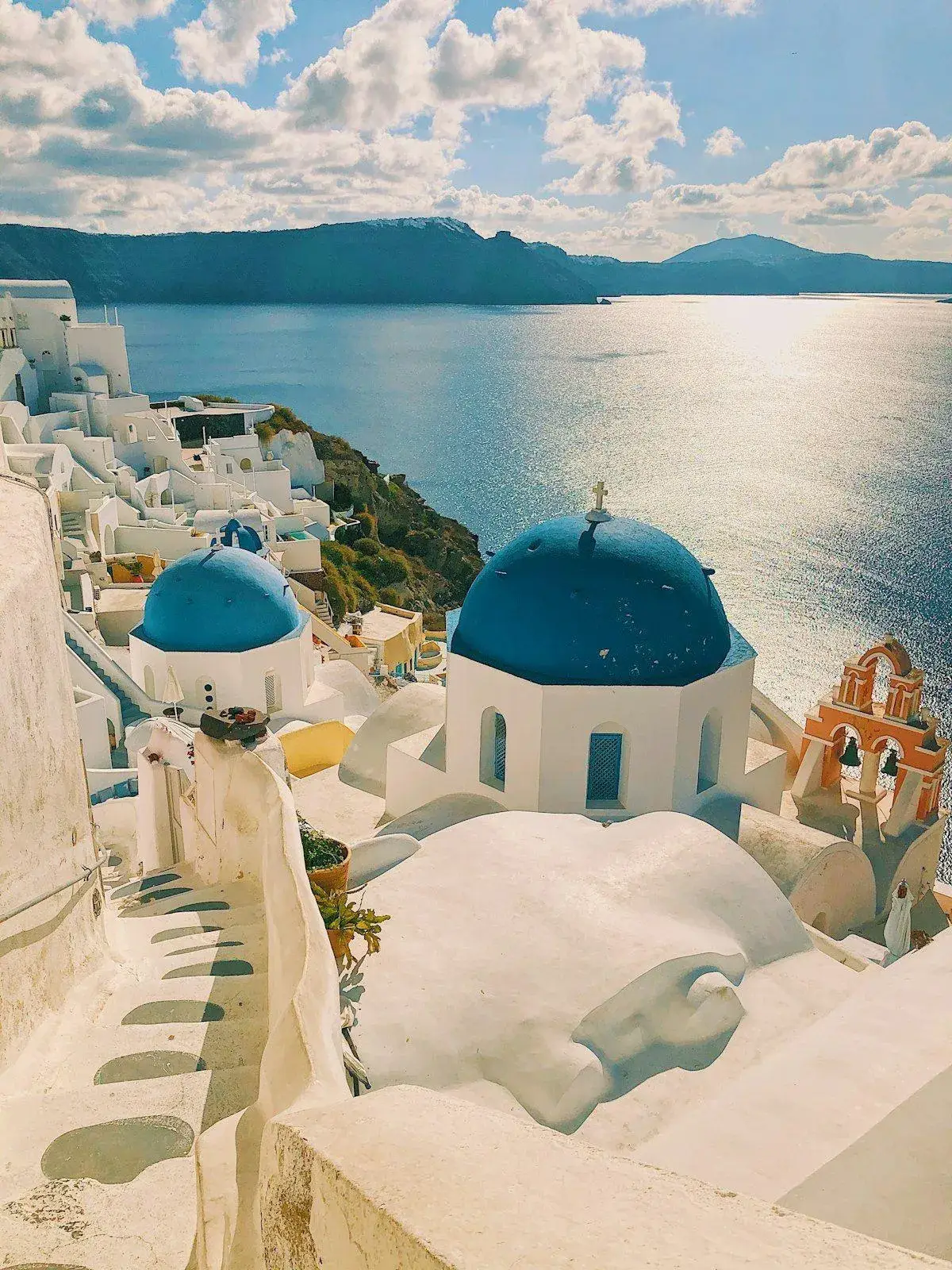
Oia is beautiful. The narrow lanes tumbling down the cliff, blue-domed churches against white walls, the sunset view from the castle ruins. If you've seen a photo of Santorini, you've almost certainly seen Oia. It deserves the reputation.
But Oia has trade-offs that most travel guides conveniently forget to mention.
Oia is expensive. Not just hotel rooms, everything. Meals and drinks on a caldera terrace cost more than in Fira, and hotels run about EUR 300-1,000+ a night against EUR 120-400 in Fira. Over four nights, that gap adds up. And that's before the extra taxi rides.
Oia is far from everything else. It sits on the northern tip of the island, 11 kilometers from Fira. Beaches, the port, the airport, wineries, Akrotiri, everything requires a 20-30 minute bus ride or drive. And every trip starts with navigating Oia's steep, narrow streets to the bus stop. If the bus is full, which often happens in summer, you wait for the next one, and taxis are hard to find at peak times.
That famous sunset? It's a crowd event. The castle ruins draw hundreds of people every summer evening. You claim your spot 45-60 minutes early. The experience is more shoulder-to-shoulder spectacle than quiet romance. Here's the thing most guides skip: the sunset looks the same from Fira, Firostefani, or Imerovigli. Same caldera, same sun, same direction, with far fewer people around you.
Oia is more geared to visitors. The village is gorgeous, but the character has shifted. Most storefronts are jewelry shops, galleries, and souvenir stores. The ratio of tourist infrastructure to authentic island life has tipped further here than in Fira, where locals still live, work, and eat next to visitors.
When Oia makes sense: If the blue-dome aesthetic is your priority, for photography, for the memory, for the sheer visual impact, Oia gives you something Fira genuinely can't match. If cost isn't a primary concern and you plan to spend most of your time within the village, eating on caldera terraces and wandering lanes, it works. Couples on honeymoons sometimes pick Oia specifically for the look, and that's a valid reason. Just go in with open eyes about cost, isolation, and crowds.
Full breakdown in our dedicated Fira vs. Oia guide.
Population: ~500 Walk to Fira: About 20-25 minutes along the caldera path Walk to nearest restaurant: 5-10 minutes (very few options) Caldera views: Yes, the highest point on the caldera Price range (double/night): about EUR 250-900+, shoulder to high season
They call it the "Balcony of the Aegean." Earned, not invented. Imerovigli sits at the very top of the caldera rim, above Firostefani, well above Fira. Skaros Rock, a headland jutting out with medieval fortress ruins, is one of the most photogenic spots on the island.
Imerovigli is quiet. That's the whole pitch, and also the whole limitation. Only a handful of restaurants in the village. No nightlife. Nothing to do after dark except sit on your terrace with a glass of wine and stare at the stars. If that sounds like paradise to you, this is your place. If you'd go stir-crazy by night three, it isn't.
The practical challenge: that 20-25 minute walk from Fira. Beautiful walk. But it's on uneven stone with some elevation changes, and after your third round trip of the day it gets old. At night the path is poorly lit. Plenty of guests end up calling taxis, and you already know the taxi situation.
Hotels here trend toward understated luxury. Some of the island's most elegant boutique properties, quieter and often more refined than flashier Oia spots, at lower prices. The trade-off is access: only an hourly bus to Fira, and you depend on Fira or a car for anything beyond your hotel.
Best for: Couples who want quiet and plan to spend serious time at their hotel. Return visitors looking for a different pace. Anyone unbothered by the walk to Fira or limited dining options nearby.
For more on choosing between caldera towns, see our Fira vs. Oia comparison.
Population: ~700 Walk to Fira: About 8-10 minutes along the caldera path Walk to nearest restaurant: 3-5 minutes Caldera views: Yes, including the famous blue-domed church Price range (double/night): about EUR 180-600, shoulder to high season
Technically a separate village. In practice, Fira's quieter neighbor. You walk from one to the other in under ten minutes along the caldera path, and the transition is seamless. Firostefani is also home to one of the most photographed churches in all of Greece: the Three Bells of Fira (Church of the Dormition), the blue-domed church that people constantly mistake for Oia.
The best-of-both-worlds argument: Caldera views and a peaceful atmosphere, with Fira's restaurants, bus station, and nightlife within easy walking distance. Quieter than Fira, more accessible than Imerovigli, significantly less expensive than Oia.
The village has a small but growing restaurant scene, a few cafes, and a relaxed residential vibe. The caldera path here is one of the most gorgeous stretches on the island, the views of the volcano and Nea Kameni (the active volcanic island floating in the middle of the caldera) are spectacular.
The trade-off: Small village. If your hotel doesn't suit you, there aren't many alternatives within steps. And while the walk to Fira is short, it's uphill on the way back, Firostefani sits slightly higher. After a long day of exploring, that starts to matter.
Best for: Couples who want the caldera experience with less noise. People who like being a short walk from everything without being in the middle of it. Photographers, the views from this stretch of path are extraordinary.
Not everyone needs a cliff-edge hotel. If you care more about beach access, flat terrain, or a much lower price point, the eastern coast is a completely different Santorini. Santorini.com's area guide has maps of these areas if you want a visual reference.
Long stretch of organized black-sand beach, waterfront promenade lined with restaurants and cafes, an open-air cinema showing English-language films on summer evenings. Kamari is the more polished of the beach towns, slightly upscale. Hotels run about EUR 80-200 a night, according to Santorini Secrets' 2026 area guide, well below caldera prices.
About 20 minutes from Fira by bus. The beach is well-organized with sunbed rentals (EUR 10-15 for two beds and an umbrella), calm clear water, and the massive rocky headland of Mesa Vouno rising up behind it.
Best for: Families, couples watching costs who still want a pleasant atmosphere, beach lovers planning to mix beach days with caldera day trips.
Perissa is Kamari's more relaxed cousin. Similar black-sand beach, more backpacker-and-beach-bar energy. Beach clubs play music, cocktails flow, the crowd skews younger. Perivolos, technically the southern extension of Perissa's beach, has some of the island's liveliest beach clubs.
Most affordable hotels on the island here: about EUR 70-180 a night. Arguably better for swimming too, wider beach, gentler entry into the water.
Best for: Younger travelers, value-minded visitors, beach-first vacationers, anyone who doesn't mind trading the caldera view for sand between their toes.
No caldera views. No cliffside architecture. No sunset from your terrace. You'll bus or drive to the caldera for all of that. For many travelers, a few day trips are enough. For others, especially first-timers and couples on romantic getaways, being on the caldera is the entire reason they chose Santorini.
The type of hotel matters almost as much as the location. Here's what each category actually looks like. Prices follow the village more than the hotel type, so use the price ranges by area above.
The most quintessentially Santorini option. Hotels built into (or designed to replicate) traditional cave dwellings carved into the caldera cliff. White-washed walls curving overhead, smooth stone surfaces, interiors that stay cool in August without cranking the AC. We cover cave hotels in detail below and in our complete cave hotel guide.
Found in: Fira, Firostefani, Imerovigli, Oia
Small properties, 8-25 rooms usually, with distinctive character and service that remembers your name. Santorini's boutique scene is excellent, particularly in Fira and Oia. The good ones help you plan your days, arrange experiences (catamaran cruises, wine tours, transfers) directly, and care in a way chain hotels simply don't. For a ranked breakdown by town and price tier, see our Santorini luxury hotels guide.
Found in: All caldera towns
We compare them village by village in our guide to boutique hotels in Santorini.
A handful exist, mostly in beach towns or set back from the caldera edge. Pools, more facilities, sometimes a spa. But they lack the intimacy and cliff-edge drama that define Santorini. Unless you specifically want resort-style amenities, the boutique and cave options are a better match for this island.
Found in: Kamari, Perissa, some caldera locations
Growing segment. Caldera-view apartments, villas, and traditional houses, sometimes less expensive than hotels, especially for longer stays or larger groups. The trade-off: no concierge, no breakfast, no help arranging anything, and quality swings wildly. Read reviews with suspicion. Be skeptical of photos that seem too good for the price. They usually are.
Found in: Island-wide
One of the most requested features on the island. Private jacuzzi, indoor or outdoor, with caldera views. Our complete Santorini jacuzzi suite hotels guide covers types, pricing by town, and what to ask before booking. Options range from heated indoor plunge pools in cave suites to outdoor jacuzzis on private terraces. At Aroma Suites, our Private Villa with Outdoor Heated Jacuzzi has an outdoor heated jacuzzi on its own balcony, and the Jacuzzi Cave Suite has an indoor heated jacuzzi built into the cave architecture. These book out months in advance for peak summer. Full breakdown of what to look for in our private pool hotels guide.
Found in: Fira, Firostefani, Imerovigli, Oia
For couples seeking honeymoon suite recommendations, see our Santorini honeymoon planning guide and honeymoon and couples guide.
A cave hotel in Santorini is built into, or designed to evoke, traditional cave dwellings. Curved white-washed walls, arched ceilings, naturally cool interiors. Found across Fira, Firostefani, Imerovigli, and Oia.
First-timers always ask: what exactly are these? Are they actual caves? Dark? Claustrophobic? Worth paying extra?
Not a hotel gimmick. A centuries-old building tradition. The island's volcanic rock, pumice and volcanic ash, is soft enough to carve but hardens over time. Perfect for excavating rooms directly into the caldera cliff. Islanders did this for generations: homes, churches, wine cellars, storage. Cave homes stay cool in brutal summer heat, warm in winter, and shrug off the Meltemi winds that batter the Aegean from June through September.
When tourism arrived, many traditional cave houses became hotel rooms. New construction adopted the same aesthetic, curved ceilings, built-in furniture, white-washed everything.
The walls are thick and curved, often with a natural arch overhead. Plaster smooth and cool under your hand. Light pours in from the front (which faces the caldera) and fades to a soft amber glow deeper inside. The acoustics are hushed. You feel insulated from everything in a way a standard hotel room never manages.
Most modern cave suites aren't rough-hewn caverns. They're beautifully finished spaces, cave architecture with modern plumbing, climate control, quality linens, and usually a private terrace with caldera views. Some have indoor heated jacuzzis tucked into curved alcoves. Others open onto outdoor terraces with plunge pools.
Honest answer: depends on the room. A small cave room with low ceilings and no window beyond the front door? It can feel tight, especially at night. But a well-designed cave suite with high arched ceilings, thoughtful lighting, and an open layout flowing toward the terrace? Spacious and serene. Not confined. The key is studying room photos carefully, pay attention to ceiling height and layout, not just the terrace view.
Neither, universally. Cave rooms are more atmospheric, more uniquely Santorini, cooler in summer. Modern rooms tend to have more natural light, more predictable layouts, sometimes more space. Personal call. But if you came to Santorini specifically, not just any Greek island, a cave room puts you inside the geology that makes this place what it is.
Full breakdown (how to spot real cave rooms vs. "cave-style" marketing, best options by town, what to ask before booking) in our complete cave hotel guide. We also cover what "caldera view" really means in our luxury hotels guide, including how to avoid rooms that face sideways.
Booking directly with a Santorini hotel often gets you more for the same rate than going through an OTA. Hotels pay the OTA a commission on every booking, typically 15-18% on Booking.com's standard tier and more for extra visibility, according to Hotel Tech Insight. Many pass those savings back to direct bookers as perks, free transfers, wine, room upgrades, best-price guarantees.
Most Santorini guides skip this topic entirely. Probably because they earn commissions from the platforms we're about to discuss.
You book through Booking.com, Expedia, Hotels.com. The hotel pays a commission to that platform, a share of your room rate. That comes straight out of the hotel's revenue.
For large hotel chains, it's a rounding error in a massive marketing budget. For a small boutique hotel with six, ten, fifteen rooms? That commission is the gap between investing in guest experience and cutting corners. When a guest books directly, the hotel puts that saved commission back into service, amenities, and perks.
This is why so many Santorini boutique hotels offer direct booking incentives: complimentary wine, free airport transfers, room upgrades, best-price guarantees. Not gimmicks. The hotel passing saved commission back to you.
Most OTAs require "rate parity", the hotel can't show a lower price on its own website than on the OTA. But perks and added value fall outside those agreements. The room rate looks the same. The direct booking includes extras, a bottle of Assyrtiko wine, a sunset airport transfer, late checkout, that the OTA booking doesn't.
Before booking any Santorini hotel through an OTA, take two minutes. Visit the hotel's own website. Look for direct booking perks. Compare total value, not just the nightly rate. For small boutique hotels especially, the direct booking often comes with extras, and you get a direct line to the hotel for planning your stay.
To see the difference for yourself, try booking directly with Aroma Suites.
Santorini hotel prices swing wildly. From about EUR 70-80 a night in a beach town to EUR 1,000+ in Oia, for a double from shoulder to high season. The best value months are late May through June and September, warm weather, thinner crowds, caldera-view rooms below their July-August rates. Understanding the seasonal curve can save you hundreds. Or it can help you grab the room you want before it vanishes.
April and early May (low shoulder). Hotels opening for the season, prices at their lowest. Warm weather (20-25 degrees) but cool sea. Thin crowds. Some restaurants and beach bars still shuttered. If you care more about caldera views, hiking, and culture than swimming and nightlife, this is excellent value.
Late May through June (high shoulder). The sweet spot for most travelers. Warm (24-28 degrees), the sea starting to cooperate, everything open, and prices below July-August rates. Book a few weeks ahead and you'll still find good rooms, though the popular hotels fill early.
July and August (peak). Maximum everything. Prices, crowds, heat (30-35 degrees). The best caldera-view rooms sell out months in advance. Expect the top of each village's range, about EUR 400 a night in Fira and EUR 1,000+ in Oia. Advance booking is non-negotiable.
September (high shoulder). Many experienced travelers swear September is the best month on Santorini. Summer crowds thin out, the heat eases (25-28 degrees), and the sea is at its warmest from three months of accumulated summer sun. Prices drift back to shoulder levels. And the light, softer, more golden than August's harsh midday glare. September light is something else entirely.
October (low shoulder). Prices drop further. Some hotels and restaurants start closing for winter toward month's end. Weather gets unpredictable. Early October can be lovely. Late October is a coin flip.
November through March (off-season). Most hotels shut entirely. The island goes quiet, about 15,000 locals going about daily life. A handful of hotels and tavernas stay open in Fira. Beautiful for atmosphere. Limiting for everything else.
July-August: 3-6 months in advance. The best rooms, especially cave suites with caldera views and jacuzzis, are gone by March or April.
May, June, September: 1-3 months ahead. More flexibility, but popular properties still fill up.
April and October: 2-4 weeks is usually enough. Last-minute offers are common.
General rule: The smaller the property, the earlier it books out. A six-room boutique hotel isn't a 200-room resort. Once it's full, that's it.
For most first-time visitors, Fira. It's the capital and transportation hub, with the widest restaurant selection, the central bus station (connections to every beach and village), and caldera views comparable to any other town at lower prices. Couples, honeymooners, anyone wanting to explore the full island, Fira is the most practical and rewarding base.
Depends on your priorities. Fira is more central, more affordable, has more restaurants and nightlife, and makes getting around easier. Oia is more photogenic, more exclusive, and famous for its sunset views, but geographically isolated, significantly more expensive, and crowded in summer. Convenience and value? Fira. Iconic blue-dome aesthetic and the spending power to match? Oia. Full comparison in our Fira vs. Oia guide.
Depends on what you want. For the most authentically Santorini experience, a cave-style hotel on the caldera gives you something nowhere else on earth offers. For couples, a boutique hotel with personalized service and a caldera-view terrace. For beach lovers and value-minded travelers, the hotels along Kamari or Perissa offer good value and a completely different atmosphere.
The four caldera villages serve different travelers. Fira is best for first-timers and explorers (most central, best access). Oia is best for those who prioritize aesthetics and can handle the premium. Imerovigli is best for quiet luxury. Firostefani is best for couples who want calm with Fira ten minutes away on foot. Details in our Fira vs. Oia comparison.
Oia is the most photographed village on the island, and it deserves that distinction. But "prettiest" is subjective. Many visitors find the caldera path between Fira and Imerovigli just as stunning, particularly the stretch near Firostefani where the Three Bells of Fira (Church of the Dormition) overlooks the volcanic islands. The views from Imerovigli's Skaros Rock rival anything in Oia, minus the crowds. For hidden beautiful spots, see our Santorini travel guide.
Three to five. Three covers the highlights: caldera walking, catamaran cruise, Oia visit, sunset watching. Five lets you explore beaches, wineries, villages, and archaeological sites. Seven lets you actually relax. Most couples land on 4-5 as the sweet spot (how long to stay in Santorini, trip by trip). And where you stay matters more with shorter trips, Fira maximizes your time because everything is reachable quickly. Planning details in our things to do in Santorini guide.
The sunset, the blue domes, and social media. Those images have been shared millions of times. Oia is beautiful, no question. But popularity has also made it crowded at sunset, very expensive, and heavily tourist-oriented. It delivers a visual experience unlike anything else on the island. The practical trade-offs, isolation, cost, crowds, mean it's not the right base for everyone.
Yes. Santorini is open and official travel advice treats it like the rest of Greece. The 2025 earthquake swarm has faded, though a few harbours and paths below the cliffs still have access rules; our Santorini safety guide covers them with sources. According to the Greek National Tourism Organisation, it's one of Greece's most popular and well-served island destinations. Main practical concerns: sun exposure (high SPF, stay hydrated), uneven caldera paths with low walls and steep drops (watch your step after dark), and the Meltemi wind from June through September that can make seas rough.
If you stay in Fira, you don't need one. Buses connect to every major destination and the town is walkable. If you stay in Oia, Imerovigli, or a beach town and want freedom to explore, a car helps. Rentals start around EUR 40-50 per day in summer. Be ready for narrow roads, scarce parking, and steep terrain. ATVs are popular but riskier, check that your travel insurance covers them.
Three questions. That's all it takes.
1. What view do you want to wake up to? If "the caldera", that panorama of volcanic islands, open blue, and steep cliffs, stay on the western side: Fira, Firostefani, Imerovigli, or Oia. If you prefer beach, go east: Kamari, Perissa, Perivolos.
2. How important is access? If you want to explore, different beaches, villages, wineries, ruins, the full caldera hike, Fira's central position saves time, money, and frustration every single day. If you plan to spend most of your time at or near your hotel, a quieter village like Imerovigli or a luxury property in Oia can work beautifully.
3. How much do you want to spend? Oia: about EUR 300-1,000+ a night. Fira: EUR 120-400. Beach towns: EUR 70-200 (Santorini Secrets' 2026 area guide). A four-night Oia stay runs about EUR 1,200-4,000+ on accommodation alone. Fira: EUR 480-1,600. Same caldera. Same sunset. Different credit card statement.
The most common first-timer mistake: picking the most famous village without asking whether it matches how they actually want to spend their time. The second: choosing based on a couple of hotel photos without understanding the town around it.
The best Santorini stays happen when the location fits the traveler. Read honestly. Compare honestly. Pick the town that matches your priorities, not the one with the most followers.
If Fira sounds right, take a look at Aroma Suites' rooms and suites, a cave-style boutique hotel on the caldera edge with volcano views. We offer a best-price guarantee when you book direct, complimentary wine for stays of three nights or more, and a free one-way airport transfer for stays of four nights or more. No OTA commissions, no middlemen, just a direct line to us.
If you prefer a more modern boutique feel with a pool, our sister property Uma Ray Suites is also in Fira on the caldera. And for couples or small groups who want the privacy of an entire villa, Casa di Terra Villa offers that on the island. Same ownership, same local knowledge, different experience.
If you're leaning toward Fira, and for the reasons above, most travelers should, we'd love for you to consider Aroma Suites. Small cave-style hotel built into the caldera cliff in central Fira. Caldera views from every room but one, our underground jacuzzi cave suite. Bus station and the best restaurants within a few minutes' walk. A team that knows the island well enough to help you plan catamaran cruises, wine tours, and sunset dinners.
Rooms range from intimate doubles to a private villa with an outdoor heated jacuzzi overlooking the volcano. Couples and honeymooners are the guests we know best.
When you book directly on our website, you get:
Have questions about where to stay or need help planning your Santorini trip? Get in touch, we're happy to help, even if you don't end up staying with us.
Planning a Santorini trip?
Get our insider guide
Local tips, hidden spots, and an exclusive direct booking discount delivered to your inbox.
Stay with us
Six rooms and a private villa on the caldera in central Fira. Direct booking includes complimentary wine on 3+ night stays and free airport transfer on 4+ nights.
Cave suite with caldera-facing veranda, designed for couples and milestone trips.
View room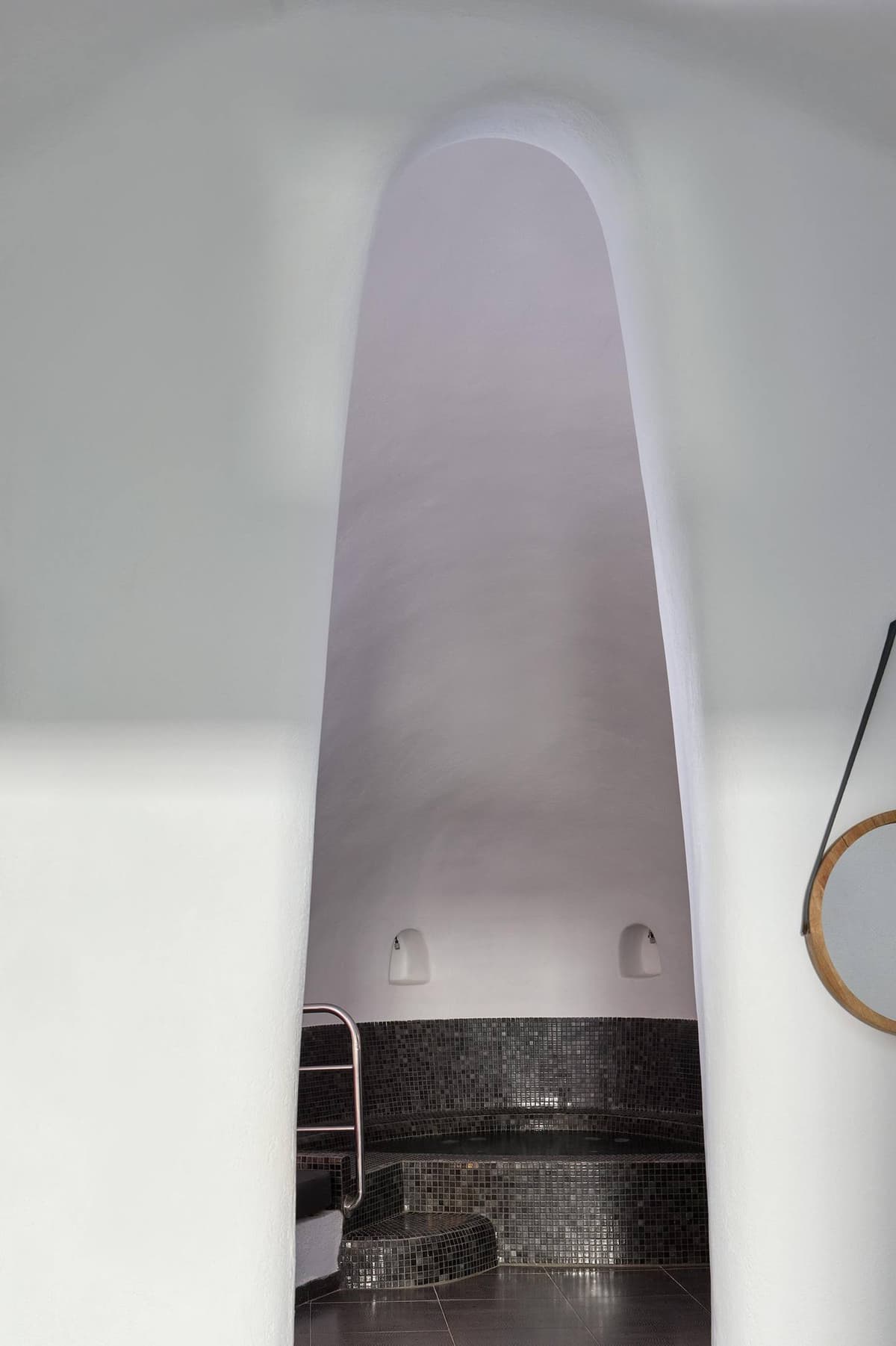
70m² cave suite with heated indoor jacuzzi and arched ceilings.
View room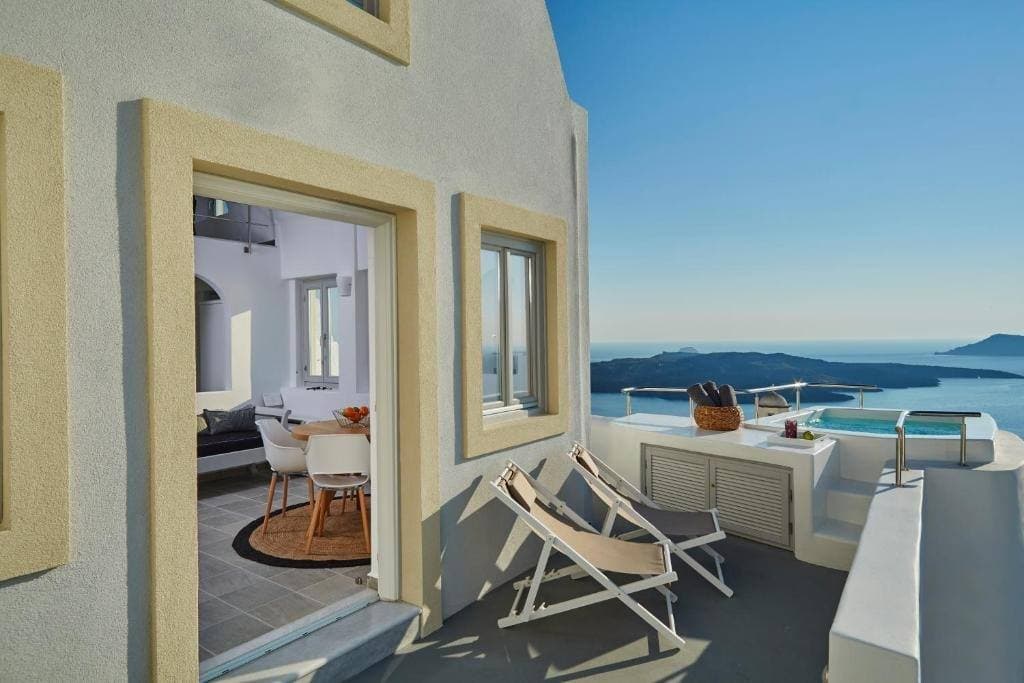
Heated outdoor jacuzzi on your own balcony, with the caldera and the sunset in front of you.
View roomYour Stay Awaits
Experience Santorini from a cave suite perched on the caldera edge in Fira.