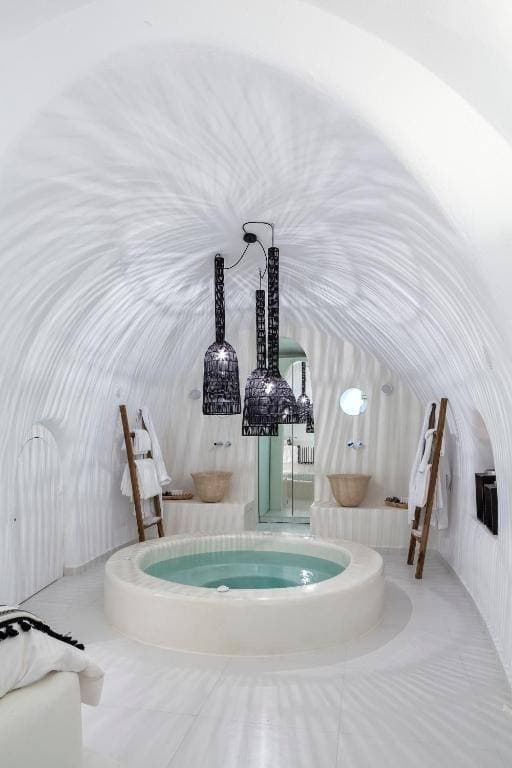
50m²
Σουίτα Μήνα του Μέλιτος
Υπόσκαφη σουίτα με βεράντα προς την καλντέρα, για ζευγάρια και ξεχωριστά ταξίδια.
Δείτε το δωμάτιο
Travel Guide
By Fanis Kafouros, Owner since 2006 · Published · Updated
Santorini is one of those rare destinations that lives up to the photographs. The whitewashed villages, the volcanic caldera, the light that turns everything golden at dusk. It's all real, and it's even more striking in person.
Quick Answer: First-time visitors to Santorini should know that Fira is the island's practical center, taxis are scarce (use buses), comfortable walking shoes are non-negotiable on the cobblestone paths, the wind can surprise you even in summer, and booking your accommodation direct often beats OTA prices. Most shops accept cards, but carry cash for buses and small tavernas.
These Santorini travel tips come from people who live on the island. Our Santorini travel guide covers the full picture, from 3-day itineraries to dining.
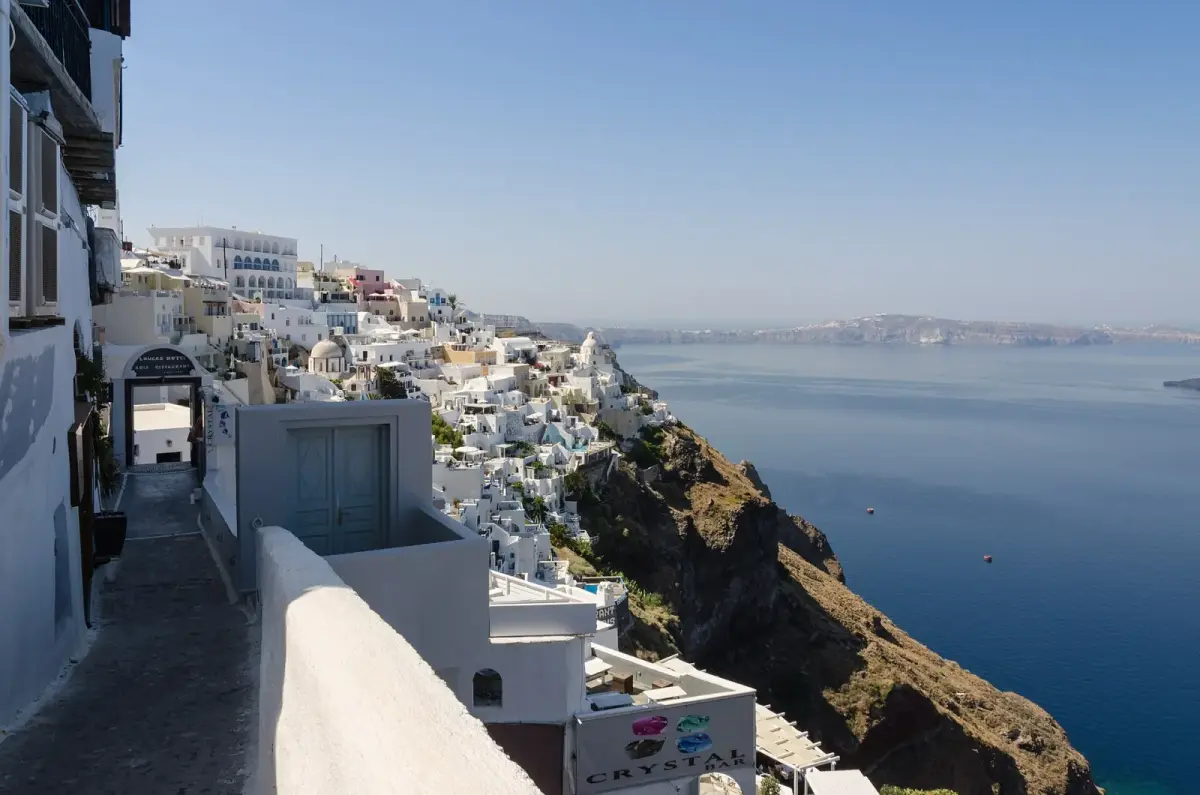
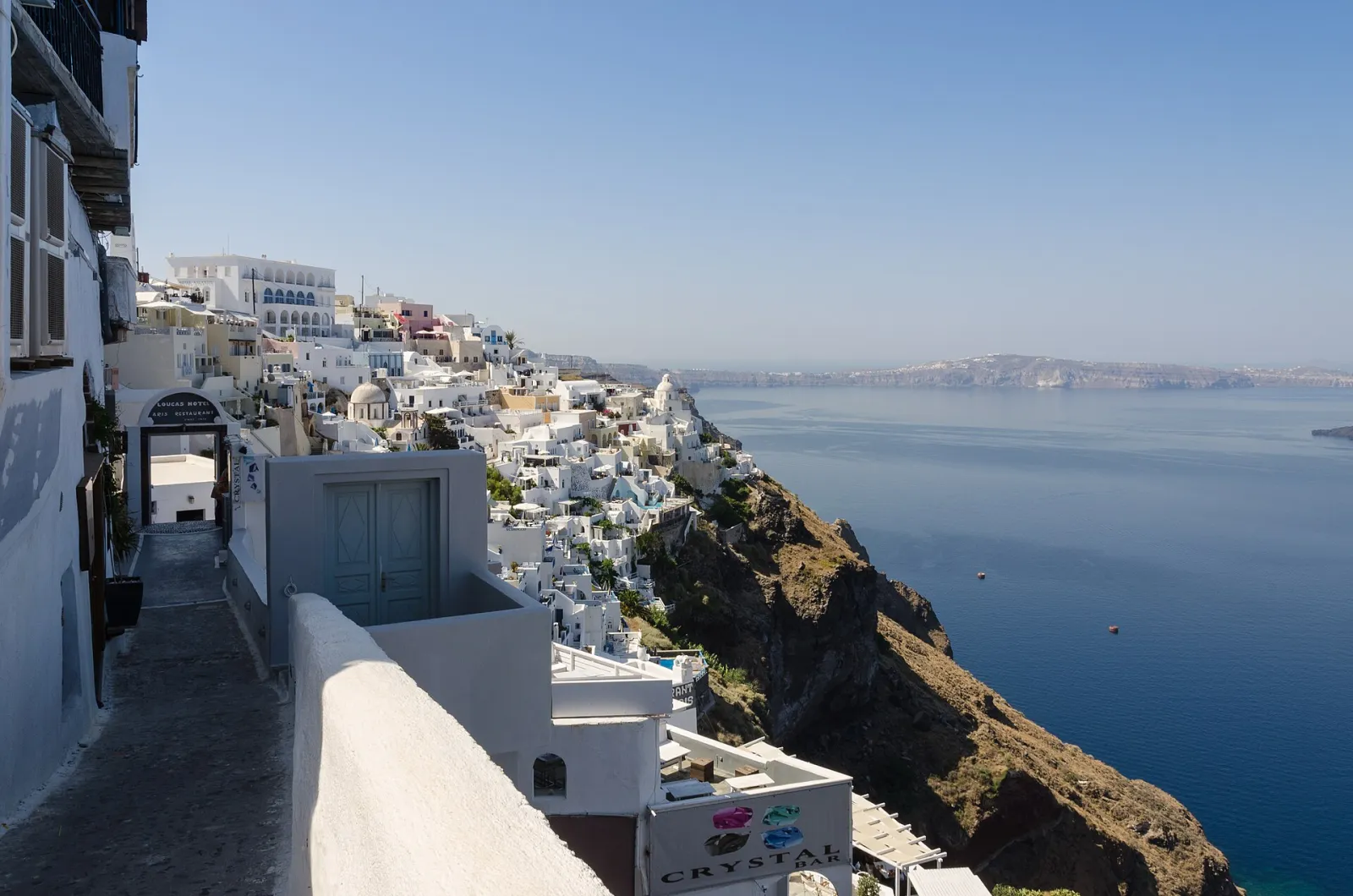 Photo: Norbert Nagel, CC BY-SA 3.0, via Wikimedia Commons
Every bus route on the island starts and ends in Fira. Every taxi passes through Fira eventually. The ferry port transfer drops you in Fira. The cable car from cruise ships climbs to Fira. If Santorini were a wheel, Fira is the hub.
This matters more than most guides let on. Staying in Oia, Imerovigli, or anywhere on the southern end? Getting to the other side means going through Fira. Stay in or near Fira and you spend less time sitting on buses and more time actually doing things.
Fira is also where you'll find the largest grocery store (Sklavenitis), the hospital, most pharmacies, ATMs from every Greek bank, and the widest range of restaurants at every price point. Not the prettiest village on the island, that's probably Oia. But it's the one that actually works as a base.
See our full guide: Getting Around Santorini for every option with 2026 prices.
This surprises everyone. Santorini has only about 35 to 40 licensed taxis, according to a local transfer operator's 2026 price breakdown. For an island that welcomes thousands of visitors daily during peak season. You can't hail one on the street. You call, you wait, and during busy periods you wait a very long time.
Better option: the KTEL bus network. Routes run from the central station in Fira to the airport, Athinios ferry port, Oia, Perissa, Kamari, and Akrotiri. Around EUR 2.20 to 2.70 per ride, per the KTEL fare table. Buses run every 30 minutes to an hour depending on route and season. Important: buses are cash only. Having exact change makes everything smoother.
For airport and port arrivals, pre-book a private transfer or confirm your hotel offers one. Many boutique hotels in Fira include complimentary transfers for stays of four or more nights. Do not count on finding a taxi at the airport. From June through September, the queue can be longer than the flight that brought you here.
Santorini is built on volcanic rock, steep caldera cliffs, and narrow cobblestone paths. The walkways in Fira and Oia are marble-smooth in places and jagged in others. Stairs are everywhere, connecting clifftop terraces, winding between restaurants, climbing from one level to the next. Flat sidewalks? Those don't exist here. With a stroller or small children, that changes where you should stay; our Santorini with kids guide goes through it.
Wedge heels. Leather-soled loafers. Brand-new sandals with no ankle support. Leave them in the suitcase. Or better yet, leave them at home. You need shoes with grip and cushioning that you've already broken in. Sneakers are perfect for daytime. For evenings, a comfortable flat sandal with a rubber sole handles restaurants and cocktail bars just fine.
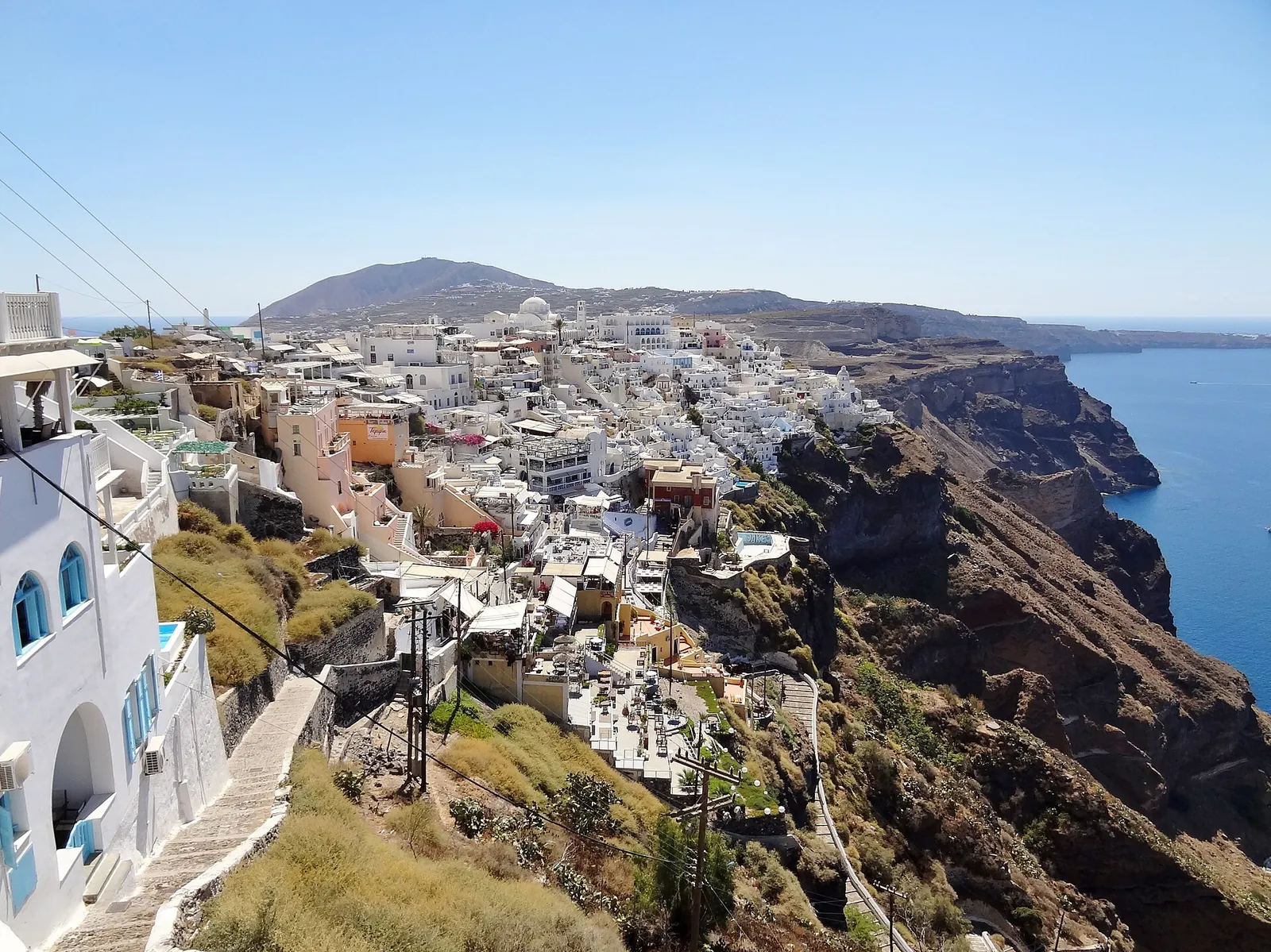 Photo: Olaf Tausch, CC BY 3.0, via Wikimedia Commons
The Fira-to-Oia caldera hike (roughly 10 km) is one of the best free things you can do on this island, but it includes rocky terrain and exposed paths. If that's on your list, bring actual hiking shoes. Your feet at sunset will thank you.
And yes, the wind. Santorini sits in the path of the Meltemi, a strong dry northern wind that sweeps across the Aegean mainly in July and August. Calm days? You barely notice it. Strong days? It will rip a hat off your head, flatten umbrellas, and turn outdoor dining into something that requires strategy.
In July and August, when temperatures push past 35 degrees, the wind is a blessing. It keeps the caldera side of the island cooler than inland areas. But evenings can feel surprisingly chilly even in summer. Pack a lightweight jacket or windbreaker. Not for rain, which is rare from May to October. For those breezy caldera-side dinners that catch you off guard.
The wind also messes with boat trips. Catamaran cruises and ferries occasionally adjust or cancel during strong Meltemi days. If a sailing trip is on your must-do list, book it early in your stay so you have backup days. Check our month-by-month guide for seasonal wind patterns.
This is the single most important accommodation decision you'll make, and most first-time visitors don't even know it exists.
Santorini has two sides. The caldera side, the dramatic western cliff edge overlooking the volcanic crater and the sea, and the non-caldera side: eastern slopes, beaches, agricultural land.
Caldera-side villages (Fira, Firostefani, Imerovigli, Oia) have the views. Hotels carved into cliffs, terraces over the caldera, sunsets from your balcony. Non-caldera areas (Perissa, Kamari, Megalochori) have beaches, lower prices, a quieter rhythm, but they're a bus ride away from the scenery you came here for.
First visit? Stay on the caldera. You didn't travel this far to watch sunset from a bus window.
Our where to stay in Santorini guide breaks down every town, but the short version: caldera-side in Fira gives you the views, the walkability, and the central location without the premium Oia charges. The Fira vs. Oia comparison explains why.
Oia's sunset is legendary. So are the Santorini crowds that come for it. During peak season, the castle ruins at the western tip attract hundreds of people. They start claiming spots two hours before sundown. Beautiful? Yes. Also loud, packed, and stressful if you were expecting a serene moment.
The entire caldera-facing western coast watches the same sunset. From Fira you can watch the sun drop into the Aegean beyond the caldera from a caldera-view terrace with an Assyrtiko in hand and nobody elbowing you. The clifftop path between Fira and Firostefani has dozens of unobstructed viewpoints, and you'll share them with maybe ten other people.
Other spots worth knowing: Skaros Rock trail in Imerovigli. The lighthouse at Akrotiri, dramatic, atmospheric, sea crashing below. Santo Wines near Pyrgos, sunset with a wine tasting overlooking the caldera.
Do the Oia sunset once. Arrive early. But don't assume it's the only option. Some of the quietest, most beautiful sunsets I've watched happened a five-minute walk from Fira's center.
Most travelers find Santorini hotels on Booking.com, Expedia, or Google Hotels. Nothing wrong with browsing there. But those platforms charge hotels 15 to 25 percent commission, and many boutique properties pass those savings directly to guests who book through their own website.
What direct booking gets you varies, but common perks include: best price guarantee, complimentary wine or welcome amenities, and transfer offers. With us, for example, booking three nights or more direct gets you a bottle of local Santorini wine in your room, and four nights or more gets you a free one-way airport transfer. You usually won't see these perks on OTA listings.
The move: find hotels on Booking.com, shortlist your favorites, then visit each hotel's own website to compare. Email them directly if you have questions. Boutique hotels respond quickly and will customize your stay in ways no booking form ever could. More on why this matters in our where to stay in Santorini guide.
Greece uses the Euro. Most restaurants, shops, and tour operators in the tourist areas accept Visa and MasterCard. Contactless payment is common, you'll tap your card at many places without a second thought.
But cash is still necessary for specific things. KTEL bus fares: cash only. Small tavernas in less-touristy villages: cash preferred. Beach umbrella rentals: sometimes cash-only. And tipping is just simpler with coins.
ATMs are concentrated in Fira, several along the main square and 25 Martiou Street. A handful in Oia. One or two in the beach towns. Skip the airport ATM if you can. Worse exchange rates, higher fees. Withdraw larger amounts to minimize per-transaction fees. And when the machine asks if you want to be charged in your home currency: always say no. Choose euros. That "helpful" conversion is almost always a rip-off.
Santorini has no natural freshwater springs. The island runs on desalination plants and, in many areas, water trucked in and stored in rooftop tanks. The desalinated water is treated, technically. But locals don't drink it. The taste is poor and the plumbing across the island varies wildly.
Buy bottled water. About one euro for 1.5 liters from a grocery store. More from tourist shops. Most hotel rooms provide complimentary bottles daily. If you want to reduce plastic, refill a reusable bottle from the large water coolers that many hotels and some restaurants offer, beats buying single-use plastic for every outing.
Tap water is fine for brushing teeth, showering, cooking. Just don't fill your water bottle from the bathroom tap before heading to the caldera hike. You'll regret it.
On peak days, between one and five cruise ships anchor in the caldera and send passengers ashore via tender boats to the Old Port below Fira. Those passengers ride the cable car or walk the donkey path up. Most have six to eight hours on the island. Our Santorini tourism statistics track the cruise cap and the passenger counts.
What that means: between roughly 9:30 AM and 1 PM, Fira's narrow streets, the cable car area, and the bus station get jammed. Oia catches a second wave via bus around midday. By 4 PM, most ships have pulled their people back. The island exhales.
Plan around this rhythm. Use cruise mornings for your own caldera-view breakfast, a visit to the less-touristy southern beaches, or a wine tasting at an inland winery. Save Fira shopping, the caldera walk, and Oia for late afternoon and evening, better light, thinner crowds. Check the port schedule before your trip: cruisemapper.com shows which ships are scheduled on which dates.
Not the US. Nobody expects 20 percent on every bill. Nobody chases you down the street for not tipping. But tipping is appreciated.
Restaurants: round up or leave 5 to 10 percent. Bill is 47 euros? Leave 50 or 52. Exceptional service at a nice restaurant: 10 to 15 percent is generous. Check your bill first, some places include a service charge, and then extra tipping isn't expected.
Tour guides and boat crew (catamaran cruises, volcano tours): a tip is appreciated if you enjoyed the trip, there's no set amount. Taxi drivers: rounding up is common, but no expectation. Hotel housekeeping: 1 to 2 euros per day is appreciated, not mandatory. Coffee shops and bars: leave the small change.
The key: tip to acknowledge good service. Not out of obligation. Greeks value sincerity over calculation.
Most international visitors land in Athens and need to get to Santorini from there. Two options: a 45-minute flight or a ferry.
The flight is faster. Aegean Airlines and Sky Express run multiple daily routes. Book early in peak season, fares climb steeply as summer approaches. Athens to Santorini Airport (JTR) is straightforward, and the airport is 15 minutes from Fira.
The ferry is slower but genuinely beautiful for a first visit. The crossing from Piraeus takes 4 hr 50 min to 11 hr 30 min depending on the boat, according to Ferryhopper's route data. High-speed boats have airline-style seats; the big conventional ferries add cafes and outdoor decks. Watching the Cycladic islands appear one by one (Paros, Naxos, Ios) and then seeing Santorini's caldera cliffs rise from the sea is a moment. The slower conventional ferries cost the least, and plenty of travelers just bring a book and enjoy it.
My advice: fly one direction, ferry the other. You get the efficiency of a flight and the experience of an Aegean crossing. If you ferry in, the Athinios port arrival gives you your first view of the caldera from sea level. You won't forget it. If Santorini is one stop on a longer trip, our 10-day Greece itinerary shows how to fit in Athens and Naxos. More details in our Santorini travel guide, and the full crossing in our Athens to Santorini ferry guide.
Santorini isn't formal. You'll see designer outfits in Oia's high-end restaurants, but the prevailing dress code island-wide is smart-casual at most.
Bring: Comfortable walking shoes (see tip 3). Lightweight windbreaker or linen jacket. Sunscreen, SPF 50, the sun is fierce. A wide-brimmed hat that clips or ties on (the Meltemi will steal anything that isn't secured). Sunglasses. Refillable water bottle. Small daypack. Light layers for evenings. Swimsuit. European plug adapter (Type C, 220V).
Leave behind: Formal attire, you won't need a suit or cocktail dress anywhere. Heavy luggage, cobblestone streets and steep hotel staircases don't accommodate big roller bags. Excessive clothing in general (Santorini's boutiques are worth browsing, and you'll want suitcase space). Bug spray, the wind keeps mosquitoes manageable on the caldera side.
Pack light. Many caldera-side hotels are accessed by narrow stepped paths, not driveways. Hauling a massive suitcase up 40 steps in August heat is nobody's idea of romance.
Everyone in Santorini's hospitality industry speaks excellent English. You'll never be stuck. But greeting someone in their language turns a transaction into a moment, and Greeks genuinely appreciate the effort.
Kalimera (kah-lee-MAIR-ah), Good morning. Use it everywhere until early afternoon. Kalispera (kah-lee-SPAIR-ah), Good evening. Switch after about 5 PM. Efharisto (ef-hah-ree-STOH), Thank you. The most useful word you'll learn. Parakalo (pah-rah-kah-LOH), Please, or you're welcome. Both. Yamas (YAH-mas), Cheers. Essential at every wine tasting and taverna dinner.
Two pronunciation notes that save embarrassment: Oia is "EE-ah," not "OY-ah." Fira is "FEE-rah." Locals understand both, but getting it right earns a smile.
Peak season, July and August, brings the highest temperatures, the largest crowds, the most expensive hotels, and the most competition for restaurant tables, sunset spots, and catamaran spots. Beautiful but intense.
Shoulder season, late April through June, September through mid-October, offers warm weather, swimmable seas (especially September when the water is warmest), smaller crowds, lower accommodation prices, and the same caldera views without the crush. Our month-by-month guide to the best time to visit Santorini breaks it all down.
Dates locked into peak summer? Book everything early: hotel, catamaran, airport transfer, restaurant reservations at popular spots. Got flexibility? Aim for the last two weeks of May or the first three weeks of September. Santorini at its most photogenic, golden light, comfortable temperatures, bougainvillea everywhere, without feeling like you're sharing it with the entire planet.
Book direct for our best price guarantee, complimentary wine for stays of three or more nights, and a free one-way airport transfer for stays of four or more nights.
One of the safest destinations in Europe. Violent crime is basically nonexistent. Petty theft is rare compared to other Mediterranean islands. The real safety concerns are practical: watch your step on steep paths and uneven cobblestones (especially after wine), wear sunscreen, stay hydrated, and be cautious on an ATV, the roads are narrow and shared with buses. Standard travel sense applies. We cover the earthquakes and the volcano, with official sources, in our Santorini safety guide. You'll feel safe walking the caldera paths well after dark.
Three full days is the minimum for the highlights: caldera sunset, catamaran cruise, the hike or village exploration, a wine tasting, at least one beach visit. Four to five days lets you slow down, add a day trip to Thirassia or the volcano, discover quieter villages like Pyrgos and Megalochori. Detailed breakdown in our 3-day Santorini itinerary, and every trip length compared in how many days to spend in Santorini.
Fira. Best combination of caldera views, central location, and walkability. It's the transport hub, has the widest range of restaurants, and sits at the caldera's midpoint, making trips to Oia, the beaches, and the southern villages equally easy. Oia is more photogenic but pricier and less practical. Full breakdown in our where to stay in Santorini guide and our Fira vs. Oia comparison.
In most modern hotels and restaurants, yes. Santorini's newer plumbing handles it fine. But some older buildings, simpler guesthouses, and traditional tavernas still have narrow pipes that can't manage paper, you'll see a small bin next to the toilet. If there's a bin, use it. Your hotel will make the preference clear. It's one of those cultural adjustments that feels weird for about a day and then becomes automatic.
The non-negotiables: watching sunset from the caldera (Fira, Imerovigli, or Oia). A catamaran or sailing cruise with swimming stops. Tasting Assyrtiko at a local winery. Walking at least part of the caldera path between Fira and Oia. And visiting the Akrotiri archaeological site, a Minoan city under volcanic ash, often called the "Greek Pompeii." Complete list in our things to do in Santorini guide.
Σχεδιάζετε ταξίδι στη Σαντορίνη;
Αποκτήστε τον οδηγό μας
Τοπικές συμβουλές, κρυμμένα σημεία και αποκλειστική έκπτωση απευθείας κράτησης, κατευθείαν στο inbox σας.
Μείνετε μαζί μας
Έξι δωμάτια και μία ιδιωτική βίλα στην καλντέρα, στο κέντρο της Φηράς. Η απευθείας κράτηση περιλαμβάνει κρασί για διαμονή 3+ νυχτών και δωρεάν μεταφορά από το αεροδρόμιο για 4+ νύχτες.
Υπόσκαφη σουίτα με βεράντα προς την καλντέρα, για ζευγάρια και ξεχωριστά ταξίδια.
Δείτε το δωμάτιο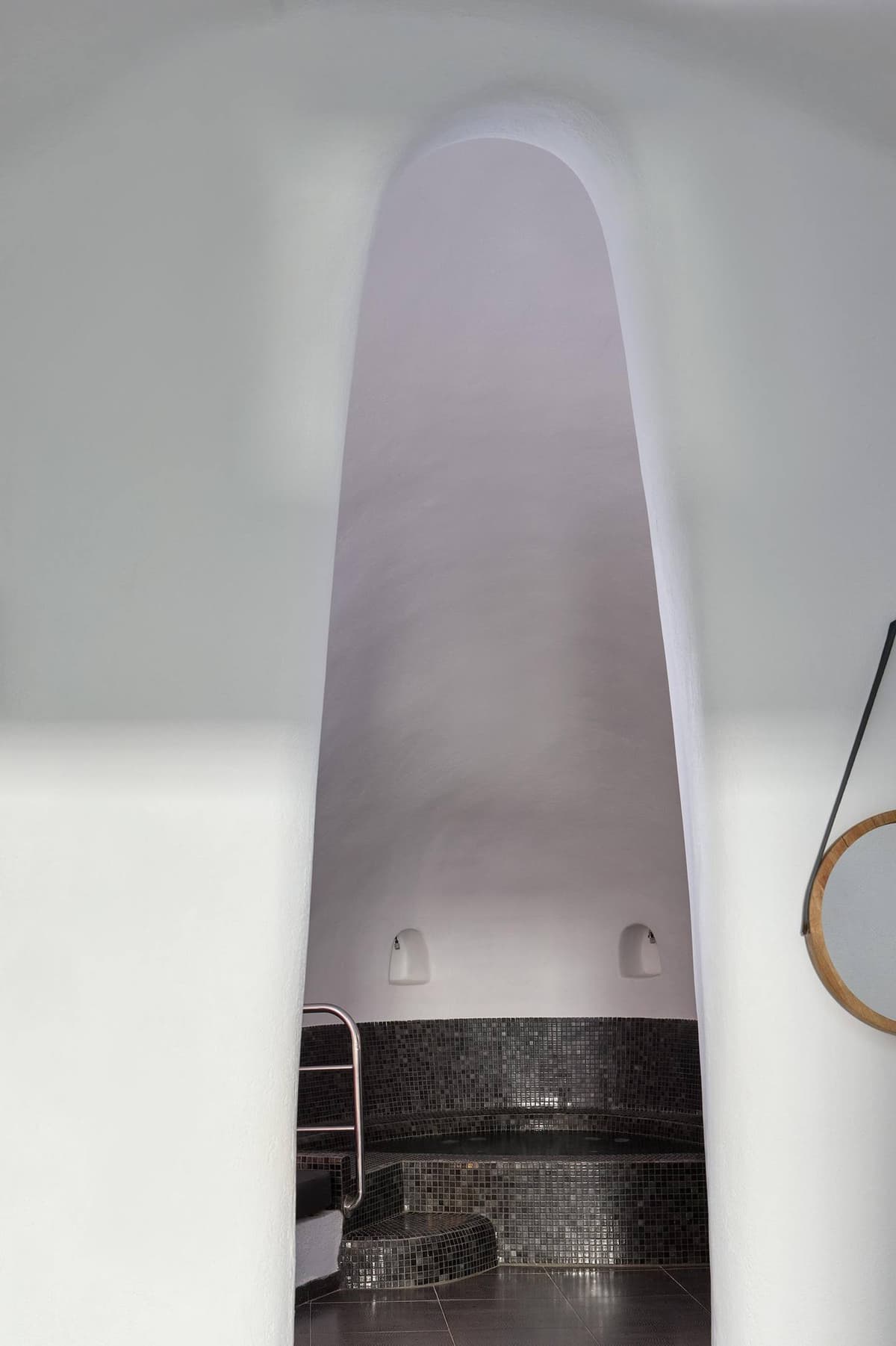
Υπόσκαφη σουίτα 70m² με εσωτερικό θερμαινόμενο τζακούζι και θολωτά ταβάνια.
Δείτε το δωμάτιο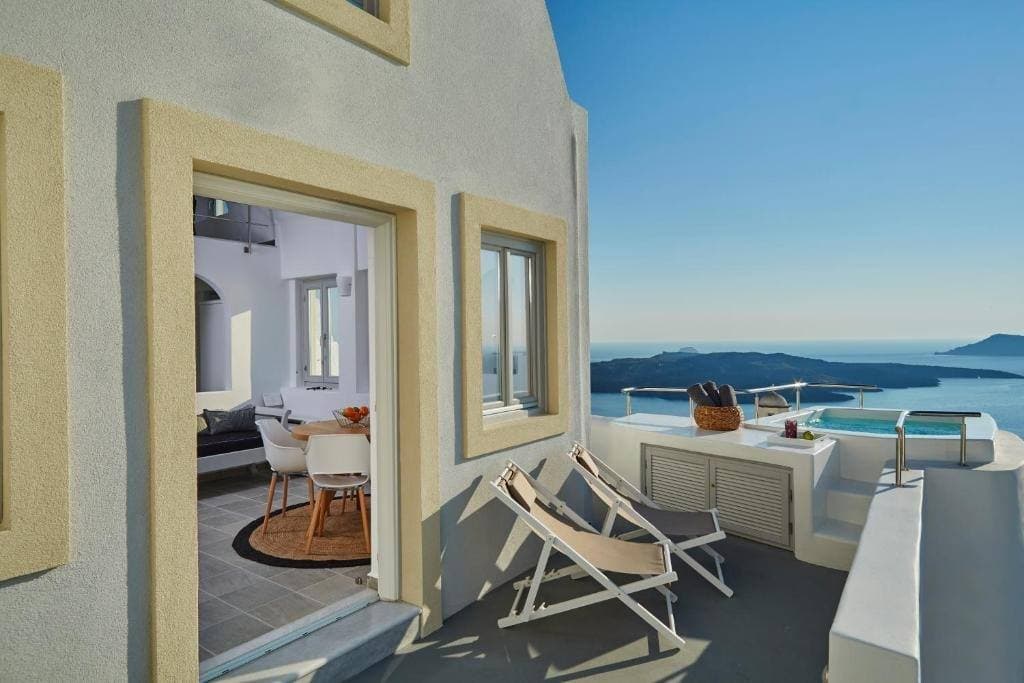
Θερμαινόμενο εξωτερικό τζακούζι στο δικό σας μπαλκόνι, με θέα την καλντέρα και τη δύση.
Δείτε το δωμάτιοYour Stay Awaits
Experience Santorini from a cave suite perched on the caldera edge in Fira.