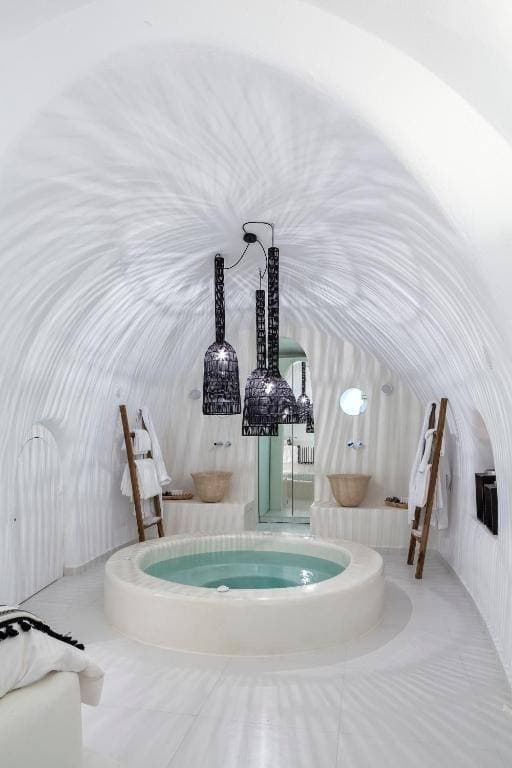
50m²
Honeymoon Suite
Cave suite with caldera-facing veranda, designed for couples and milestone trips.
View room
Hidden Gems
By Fanis Kafouros, Owner since 2006 · Published · Updated
Roughly 2 million tourists come to Santorini every year. Most follow the same well-worn circuit: blue domes in Oia, sunset at the castle, a catamaran cruise, Red Beach for a photo. But Santorini is a 73-square-kilometer island with 15 villages, dozens of beaches, and centuries of layered history.
Quick Answer: The best Santorini hidden gems include Pyrgos village (360-degree views, few crowds), Vlychada Beach (lunar cliffs), Akrotiri Lighthouse (locals' sunset spot), Megalochori (authentic wine village), the Skaros Rock hike, Thirassia island and the full Fira-to-Oia caldera trail. Most are within 25 minutes of Fira by car or bus; Thirassia takes a bus to Oia and a short boat ride.
Most visitors to Santorini follow the same loop: blue domes in Oia, sunset at the castle, a catamaran cruise, a photo at Red Beach. Those places are famous for good reason. But Santorini is a 73-square-kilometer island full of traditional villages, dozens of beaches and centuries of layered history, and most of it sits quietly waiting for anyone curious enough to wander past the postcard. This is our guide to the real Santorini.
We've spent years living and working here, exploring every corner of this place. These are 12 spots we love, the ones we take friends to when they visit and ask to see "the other Santorini." Some are genuinely unknown. Others are technically on the map but overlooked by almost everyone. We've been honest about which is which.
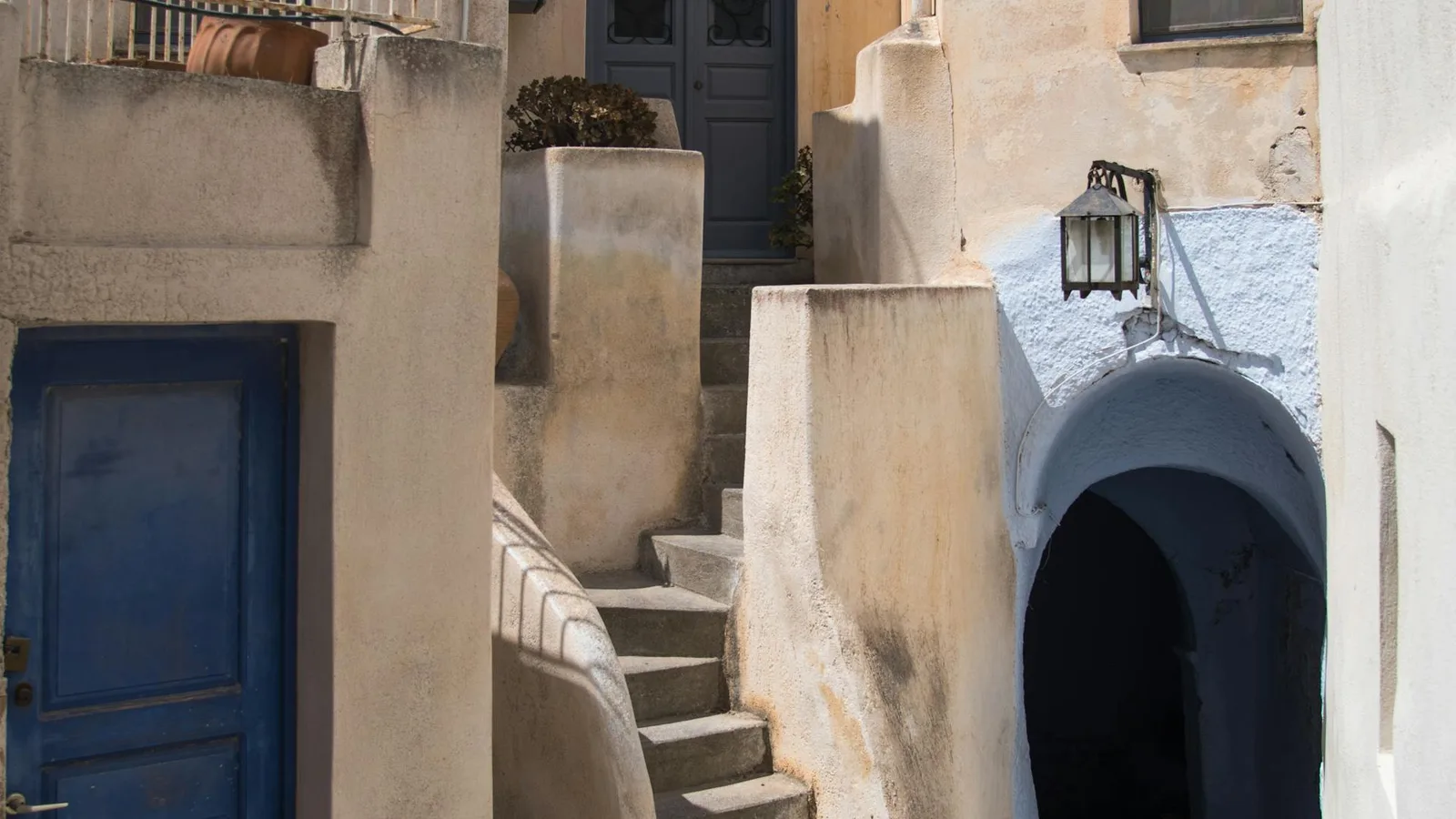
Category: Village Crowd level: Very low Cost: Free Best time to visit: Late afternoon (golden light on the stone walls) How to get there from Fira: 8-minute drive or 15-minute bus ride (Fira-Pyrgos route runs every 30 min in season)
Pyrgos is the highest village on Santorini, and we honestly don't understand why it stays so empty. From the hilltop ruins of the medieval kasteli, you can see the entire island in every direction. Caldera to the west. Aegean to the east. Oia to the north. Akrotiri to the south.
The village itself is a tangle of stone-paved lanes, blue-shuttered houses, and churches with bell towers catching the afternoon light. No souvenir shops. No tour bus parking lots. Most afternoons, the only sound is wind through bougainvillea and the occasional clatter of a cafe setting out chairs.
Climb to the kasteli at the summit for the views, then wind down through the alleyways. You'll pass tiny wine bars, a few galleries, some of the oldest residences on the island.
Insider tip: Visit during the Feast of the Prophet Elias (July 20) when locals process through the streets to the mountaintop monastery. One of the most authentic celebrations on the island. Practically zero tourists attend. The monastery just above the village is worth the short walk too, the views are even wider, and the monks sometimes sell honey and wine.
Related reading: Pyrgos is one of our top sunset spots when you want caldera views without the Oia crowd.
Category: Beach Crowd level: Low Cost: Free (sunbeds EUR 8-12 at the nearby beach bar) Best time to visit: Morning (the cliffs are fully lit before noon) How to get there from Fira: About a 20-minute drive south, or the KTEL bus from Fira (up to EUR 2.80).
Vlychada doesn't look like Greece. Doesn't look like Earth, honestly. The beach sits at the base of towering white-grey pumice cliffs sculpted by wind and water into shapes that look like melted wax, organ pipes, or the surface of the moon. Volcanic black sand stretches several hundred meters.
Unlike Perissa or Kamari, which are full-service beach resorts lined with sunbeds, Vlychada is quiet. Slightly wild. A small beach bar at one end, a tiny fishing port nearby, but the eastern end of the beach is often completely empty. Walk along the cliff base and the whole surreal landscape is yours alone.
The water is usually calm and the seabed drops off gradually, so it's good for swimming. The volcanic sand is dark but not as coarse as some of the island's other black sand beaches.
Insider tip: Walk past the main beach area, east along the cliff face. The formations get more dramatic the further you go, and you'll likely be the only person there. Bring water, no facilities beyond the main area. For lunch after, the Vlychada Marina has a small taverna where the fish came off a boat that morning. For more on local dishes and where to find them, see our Santorini food and wine guide.
Category: Viewpoint / Sunset spot Crowd level: Very low Cost: Free Best time to visit: 30 minutes before sunset How to get there from Fira: 20-minute drive to the island's southwestern tip. No bus service. Taxi or rental car required.
At the very southern tip of Santorini, the Akrotiri Lighthouse has stood since 1892. One of the oldest lighthouses in Greece. The views from the surrounding cliffs rival anything on the island. And somehow, the tour buses and sunset crowds have never found it.
The sun sets over open ocean here, no caldera framing like you get from Oia or Fira. What you lose in the classic whitewashed-village foreground, you gain in raw, cinematic drama. Sea cliffs falling away sharply beneath you. On clear evenings, the horizon line between water and sky dissolves into tangerine and violet. The wind is constant and occasionally fierce, which keeps the casual crowds away.
No restaurants. No bars. No selfie platforms. Just the lighthouse, the cliffs, and whatever you brought in your bag.
Insider tip: Combine it with a late-afternoon visit to the Akrotiri archaeological site, the "Pompeii of the Aegean", about a 10-minute drive away. Bronze Age ruins first, then drive to the lighthouse for sunset. Our favorite half-day on the island, and it fits perfectly into a 3-day itinerary.
Related reading: We ranked Akrotiri Lighthouse as one of the best sunset spots on the island, and it's our top pick for couples who want a private sunset without booking a cruise.
Category: Village Crowd level: Very low Cost: Free to walk; wine tastings EUR 10-25 Best time to visit: Late afternoon or early evening How to get there from Fira: 10-minute drive or 20-minute bus ride (Fira-Akrotiri bus stops in Megalochori)
If you asked someone to picture "an authentic Greek wine village," they'd picture Megalochori. They just wouldn't know the name. This is one of Santorini's best-preserved traditional settlements: stone arches, wood-beamed canavas (the old wine caves carved into volcanic rock), courtyard gardens heavy with grapevines, and absolute quiet.
Megalochori was the wealthiest village on the island in the 19th century, built on wine and tomato exports. The grand neoclassical houses of the old merchant families still line the main square. The village bell tower is one of the most photographed in Santorini, by locals. Tourists rarely make it here.
The main reason to visit, beyond the beauty, is wine. Megalochori is the heart of Santorini's wine culture. The canavas, those cave-hewn cellars that kept wine cool in the volcanic tuff for centuries, are still in use. Some have been converted into atmospheric tasting rooms where you can sample Assyrtiko, Nykteri, and Vinsanto in the same caves where they've been stored since the 1700s.
Insider tip: Boutari Winery on the edge of the village is the polished option among Santorini wineries. But walk a few streets deeper and you'll find smaller, family-run canavas that pour wine at a fraction of the price with twice the character. Ask any local shopkeeper. They'll point you to their cousin's canava.
Related reading: For the full rundown on the island's wine scene, see our wine tasting guide.
Category: Hike / Viewpoint Crowd level: Low to moderate Cost: Free Best time to visit: Late afternoon (for sunset from the rock) or early morning (for solitude) How to get there from Fira: About a 40-minute walk along the caldera path to Imerovigli, or 5-minute drive/taxi
Skaros Rock isn't entirely unknown. It shows up in guidebooks and on Instagram. But the vast majority of visitors who come to Imerovigli take one photo from the walkway and leave. Very few actually hike out to the rock itself. Which means on most days, you'll share one of the most dramatic viewpoints in the Mediterranean with a handful of people.
The hike starts at the main path in Imerovigli. Descends through rough-cut stone steps to a narrow ridge leading out to the rock. About 15-20 minutes each way. Not technical, but you need real shoes. No sandals. Uneven footing, no railings.
What you find at the end: ruins of a 13th-century Venetian fortress on a volcanic promontory jutting into the caldera. The view is staggering. Suspended between caldera cliffs to your left, open sea below, the entire caldera arc stretching from Oia to Akrotiri. On a clear day, Crete on the horizon.
This is a special place. The kind where you sit on warm volcanic stone, feel the wind, and understand why people have been building on these cliffs for 3,000 years.
Insider tip: Time the hike for sunset. The sun sets almost directly in front of you, and you watch the light transform the caldera walls from white to gold to rose. Far fewer people than Oia Castle. Far more dramatic. Bring a headlamp or phone light for the walk back, the path is unlit.
Related reading: The Skaros Rock trailhead is a natural stop on the Fira-to-Oia caldera hike, and one of our top romantic things to do in Santorini.
Category: Day trip / Island Crowd level: Almost empty Cost: The small local ferry from Ammoudi Bay (Oia) costs roughly EUR 1-2 each way, a 10-minute crossing paid in cash on board. Some volcano boat tours include Thirassia as a stop. Best time to visit: Full day, arrive morning, leave late afternoon How to get there from Fira: Take the bus to Oia (25 min), walk down to Ammoudi Bay, and catch the small ferry to Thirassia
Thirassia is the forgotten sibling, sitting directly across the caldera from Santorini. You can see it from any caldera-facing terrace, but almost nobody goes. The few who do find an island that feels like Santorini before the hotels, before the cruise ships, before the world discovered it.
The ferry drops you at Riva port, tiny harbor, fishing boats, one taverna. From there, a steep hike up to Manolas, the main village. About 200 residents. Roughly 200 steps. The reward at the top: whitewashed houses, a few churches, and caldera views that rival Oia's. Zero crowds.
Two or three tavernas. A bakery. A small shop. That's it. The food is simple, local, honest. The pace of life is what Santorini's villages must have felt like decades ago, before tourism remade the main island.
For the adventurous: a walking path leads north from Manolas to the tiny settlement of Potamos and eventually to a quiet pumice beach. Bring water and sun protection. Almost no shade.
Insider tip: The ferry from Ammoudi Bay runs only a few times per day. Check the schedule at the port or ask your hotel. Don't rely on apps, the schedule is informal and shifts with the season. The last boat back is typically 4-5 PM in summer. Miss it and you're spending the night. There are a couple of rooms to rent, but don't count on availability. Some volcano boat tours include a Thirassia lunch stop, convenient, but you only get about 90 minutes on the island.
Category: Hike / Experience Crowd level: Sections vary. Moderate near towns, very low between them. Cost: Free Best time to visit: Early morning (start 7-8 AM to beat the heat) How to get there from Fira: You're already there. The trail starts at the northern end of the Fira caldera walkway.
The caldera path from Fira to Oia is one of the finest coastal walks in Europe. It traces the rim of the volcanic crater for roughly 10 kilometers, through Firostefani, Imerovigli, and Oia, with the caldera dropping away to your left the entire way. On a clear morning, you can see from one end of the island to the other.
Here's what makes it hidden: almost nobody walks the full trail. Most visitors do a short stretch between Fira and Firostefani, take a selfie at Imerovigli, and turn back. The section from Imerovigli to Oia, the wildest, most dramatic, most beautiful stretch, is often nearly empty.
Full hike takes 3-4 hours at a comfortable pace, with stops. Well-marked but not paved for most of its length. The Imerovigli-to-Oia section involves rocky terrain and a few climbs. You need proper shoes, water (1.5 liters minimum), sunscreen, and a hat. No shade for long stretches.
What makes it worth the effort: you walk through the island's geology. Layers of volcanic tuff, pumice, and lava exposed in the cliff faces. Wild herbs growing from the rocks, oregano, thyme, capers. The light changing constantly as you round each bend.
Insider tip: Start from Fira early morning, hike to Oia, have lunch there, bus back (EUR 2.20, every 20-30 minutes). Starting from Fira means the sun is behind you for most of the walk, cooler and better for photography. Carry snacks. There are no shops or cafes between Imerovigli and the outskirts of Oia, a stretch of 2-3 hours on foot.
Staying in Fira? The trailhead is a 10-minute walk from Aroma Suites. Start with breakfast on your caldera-view terrace, step onto the path.
Category: Village Crowd level: Very low Cost: Free Best time to visit: Late morning or early afternoon How to get there from Fira: 10-minute drive or 15-minute bus ride (Fira-Perissa bus stops in Emporio)
Emporio is the largest medieval settlement on Santorini. For the full guide, see our Emporio and Megalochori article. Its kasteli, the fortified village center, is one of the most remarkable pieces of architecture in the Aegean. Designed, deliberately, to confuse anyone who didn't belong there.
The castle district is a labyrinth. Windowless outer walls. Dead-end passages. Low arches you have to duck through. Hidden courtyards. Staircases that lead to rooftop walkways. The streets were built narrow and winding so that pirates, who raided the island regularly from the 13th through 17th centuries, would get lost, separated from each other, and trapped. The villagers, who knew every turn, could move freely while the raiders stumbled.
Walking through it today is disorienting in the best way. Turn a corner, sunlit courtyard with a flowering tree. Duck under an arch, rooftop with a view across the eastern plains to the sea. The scale is intimate: buildings press close, ceilings are low, the walls still bear marks of centuries.
Emporio also has one of the island's finest churches, the Megali Panagia, with a blue dome that would be on every Instagram page if it were in Oia instead of here.
Insider tip: Don't use Google Maps inside the kasteli. It won't work. The streets are too narrow and irregular. Just wander. Getting lost is the entire point. When you want to leave, walk uphill until you find an exit. The square outside the kasteli has a couple of tavernas with honest food, far better value than anything in Fira or Oia.
Category: Beach Crowd level: Very low (sometimes empty) Cost: Free Best time to visit: Morning or late afternoon How to get there from Fira: 20-minute drive to the northeast coast. Follow signs toward the Colombo/Koloumbo area. The last stretch is a dirt road. No bus service.
If Vlychada is the lunar beach, Colombo is the volcanic one. Dark, almost black sand beneath dramatic cliffs on the northeastern coast, facing the open Aegean. No sunbeds. No umbrellas. No beach bars. No lifeguard. Just sand, sea, and cliffs.
Remote enough that you may have the entire beach to yourself. Even in high season. The drive is part of the experience, winding through scrubland and vineyards, past small farms, to a rough parking area above the beach. From there a steep dirt path, about 5-10 minutes on foot, leads down to the sand.
Clear, deep-blue water. More substantial waves than on the sheltered caldera side. Swimming is good, but pay attention to currents. Unmonitored beach. The volcanic rock formations at each end are striking. The cliffs behind you bear layers of pumice and ash from eruptions spanning millennia.
Insider tip: Colombo sits above an active underwater volcanic vent (Kolumbo volcano), which occasionally warms the water in patches near shore. To stand on the island's active crater itself, see our Santorini volcano tour guide. You may feel warm spots while swimming. Normal and safe. Bring everything you need: water, food, shade. Take everything out. The beach is pristine because the few people who come here respect it. Also, the beach has historically been clothing-optional and still tends that way, particularly at the far end.
Category: Experience / Winery Crowd level: Low to moderate Cost: Wine tasting from EUR 10 for 4 wines to EUR 20 for 8 Best time to visit: Late afternoon (the cave is cool, and you can watch sunset from the terrace afterward) How to get there from Fira: 10-minute drive toward Kamari. Signposted from the main road.
Art Space isn't a typical winery. It's a canava, a wine cave carved into volcanic rock, that doubles as a contemporary art gallery. Sculptures, paintings, and installations displayed among the barrels and ancient stone walls. The atmosphere is something the island's more polished, commercial wineries can't match.
The tasting is serious. The family produces Assyrtiko, Aidani, Vinsanto, and a few reds from the island's unique basket-trained vines (the "kouloura" technique, where vines are wound into low baskets to protect grapes from wind). Good wines. The setting transforms them into something you'll remember.
Unlike Santo Wines or Venetsanos, which are popular and deservedly so but draw large crowds, Art Space sees a fraction of the visitors. Unhurried pace. Staff who explain the volcanic terroir and the canava traditions without rushing you. You're sitting in a restored canava where the Argyros family has made wine since 1861, sipping from grapes grown in volcanic soil, surrounded by art.
Insider tip: Ask to see the back rooms of the cave, where the oldest barrels sit. Not every visitor gets there, but show genuine interest and the staff usually walk you deeper. The Vinsanto, the sweet dessert wine unique to Santorini, is excellent here and makes a memorable gift. Bottles start around EUR 20 for the younger vintages.
Related reading: Art Space is one of our top picks in the Santorini wine tasting guide, and a perfect afternoon before a sunset photoshoot.
Category: Food / Experience Crowd level: Low at lunch, extreme at sunset Cost: Lunch for two EUR 40-80 depending on what you order (fresh seafood) Best time to visit: 12:00-2:00 PM How to get there from Fira: Bus to Oia (25 min), then walk down the roughly 278 steps from Oia to the bay
Everyone who reads a guidebook knows about Ammoudi Bay for sunset. The tiny fishing harbor below Oia fills with hundreds of visitors every evening. They descend the stone steps, eat grilled octopus, and watch the sky turn colors. Beautiful experience, but it has become very crowded.
What the guidebooks don't tell you: come at lunchtime instead.
Noon on a Tuesday in May, Ammoudi Bay is a different place entirely. Fishing boats bobbing in the harbor. The three tavernas with open tables and water views. The grilled octopus is the same, fresh from the morning catch, charred over coals, served with lemon and olive oil. The fish is the same. The calamari is the same. What's different is everything else. The pace. The noise level. The elbow room. The feeling of having found a corner of the island that belongs to you.
You can swim, too. The water in the bay is crystal clear. At midday, you can see straight to the bottom. After lunch, some people swim to the small rock platform further along the coast, becomes an impromptu cliff-jumping spot later in the day.
The walk back up those 278 steps after a seafood lunch and a swim is honest exercise. Take it slowly. The views improve with every turn.
Insider tip: Order the "catch of the day" rather than menu standards. The taverna owners will show you what came off the boats that morning. Ask for it grilled whole with olive oil and lemon. Simple. Fresh. Better than anything you'll eat in Oia's tourist restaurants up top. The leftmost taverna (Sunset Ammoudi) tends to be marginally less crowded than the others, even at peak times.
Category: Walk / Experience Crowd level: Low (almost empty between cruise ship arrivals) Cost: Free Best time to visit: Early morning or late afternoon (avoid midday heat, especially in summer) How to get there from Fira: Start from the cable car station area in central Fira. The path begins right next to it.
It's the simplest hidden gem on this list, and possibly the most satisfying.
The zigzagging stone staircase connecting Fira to the Old Port at the bottom of the caldera is 588 steps of pure, unfiltered Santorini. The path has existed for centuries. It was the only way between the clifftop town and the harbor before the cable car went up in 1982. Today, nearly every cruise ship passenger takes the cable car. The donkey handlers still work the path, but actual walkers are few. Which means you get the steps, the caldera wall rising around you, the harbor shrinking or growing depending on your direction, and long stretches of quiet.
The views from this path are different from any other vantage point on the island. You're inside the caldera rather than perched on top of it. Volcanic layers of the cliff face directly beside you, reds, blacks, greys, whites. The sea below. Fira above like a crown.
Going down: 20-25 minutes. Going up: 30-40 minutes. Genuine workout. Steps are uneven and can be slippery. Wear proper shoes.
Insider tip: Walk down early morning, well before the first cruise ship tenders arrive (typically 9-10 AM). You'll have the path nearly to yourself. At the bottom, the Old Port has a couple of small cafes where you can catch your breath and watch the boats before taking the cable car back up (EUR 10, 3-minute ride). Watch for donkey droppings on the steps, stay to the inside edge. And if you're staying at Aroma Suites in Fira, the path entrance is a short walk from the hotel. A pre-breakfast stair descent followed by a cable car ride up is a memorable way to start any day.
Eleven of the 12 spots on this list are within 25 minutes of Fira, and Thirassia takes a bus to Oia and a short boat ride. Not a coincidence. Fira is the geographic and transport hub of the island. Buses leave from the central station to every village and beach. Taxis queue at the main square. The caldera path starts at the walkway. The Old Port steps are a 5-minute walk from the center.
Stay in Oia and you're at the end of a line. Getting to the south and east side of the island means driving through the center. From Fira, you're already there.
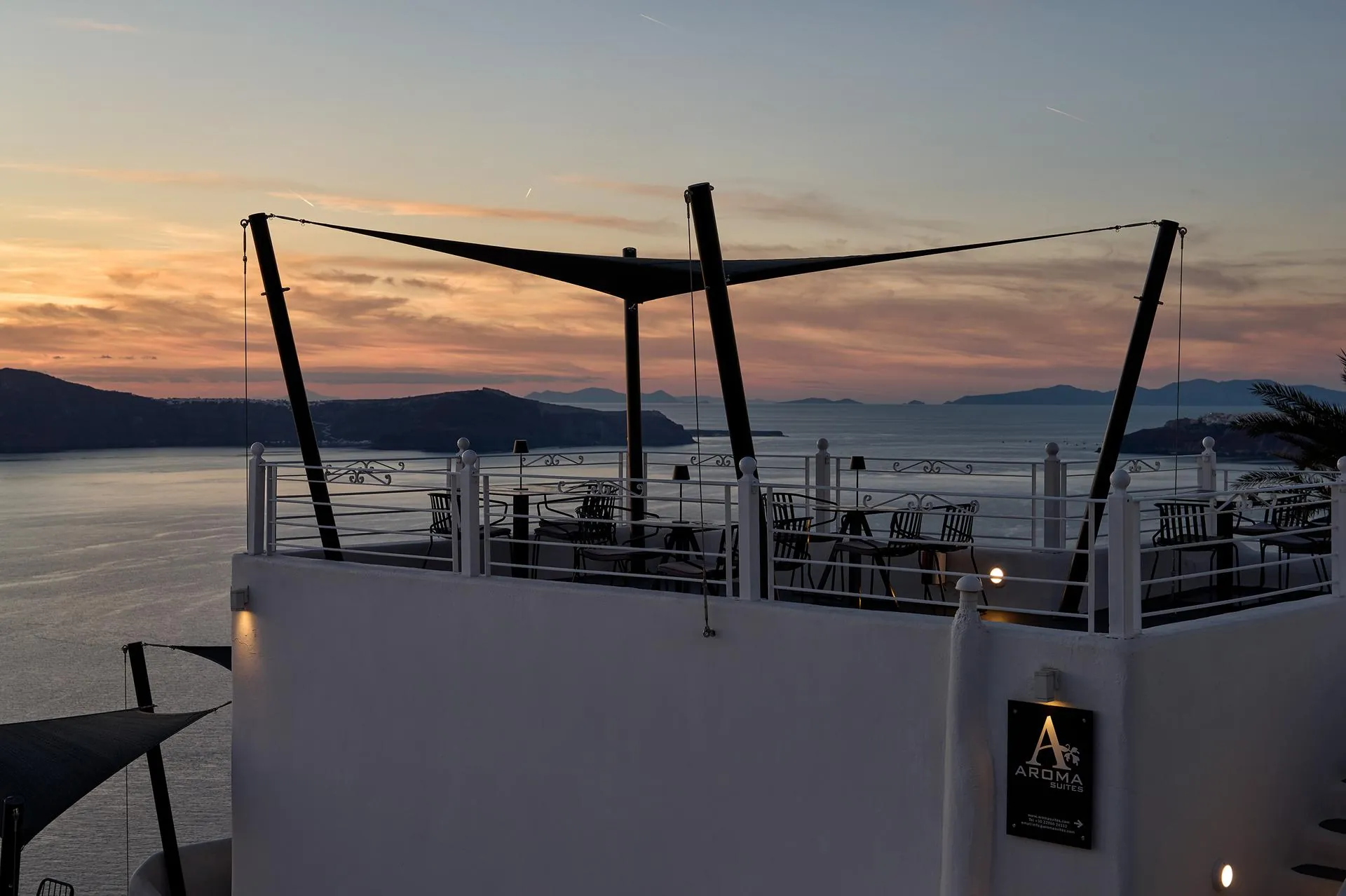
Category: Guests-only viewpoint Crowd level: Calm Cost: Included with a stay Best time to visit: Just before sunset, with a glass of Assyrtiko How to get there from Fira: A separate staircase from the hotel leads up to the roof, in central Fira
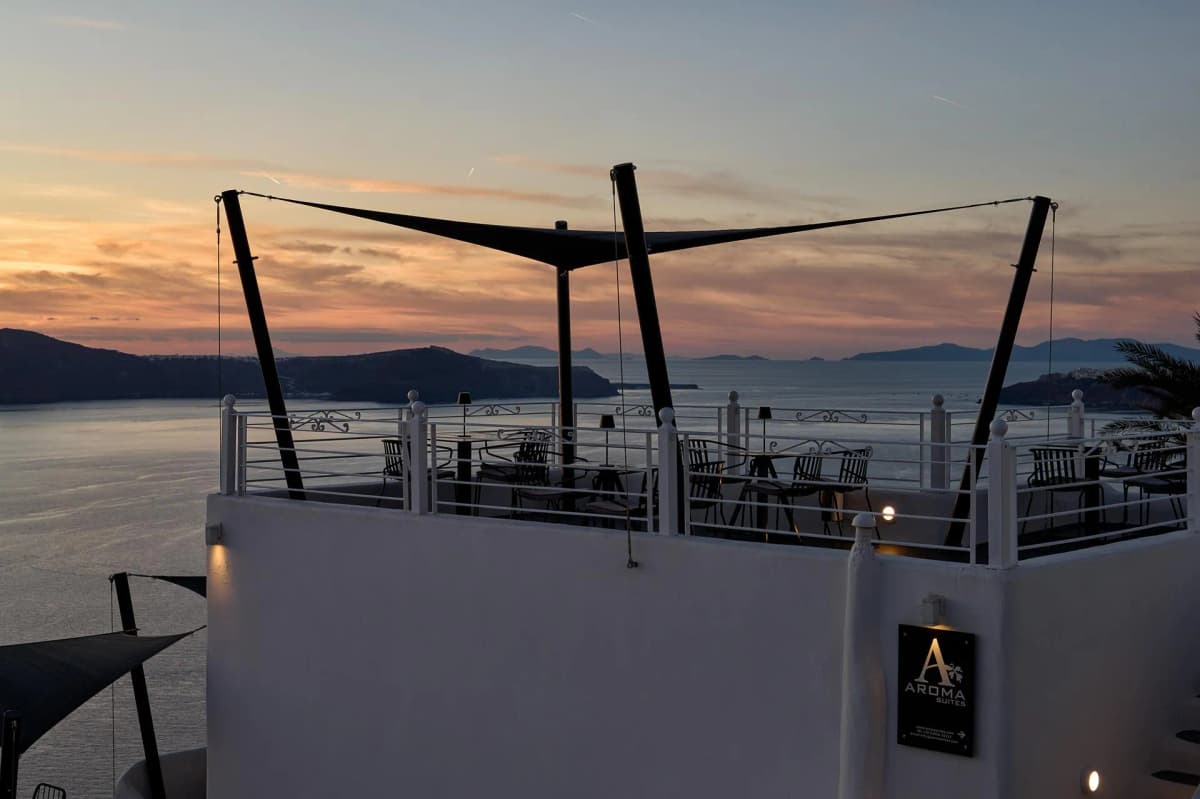
Most of Santorini's famous sunset spots come with a crowd. The wall at Oia Castle is shoulder-to-shoulder by 7pm. The Fira caldera path fills up by 7:30. Our rooftop terrace at Aroma Suites is one of the quietest places in central Fira to watch the sun go down. The view spans the full caldera, the volcanic islands, and the sunset in one direction, with a quiet view over the village rooftops in the other. On clear evenings you can see from Oia in the north to Akrotiri in the south, with Nea Kameni and Palea Kameni centered in between. It's open all day to anyone staying with us, the tables are shared among guests, and drinks are served at sunset.
If you're not staying with us, the Akrotiri Lighthouse is the closest free equivalent, open to anyone, no crowds. See #3 above for more on it.
Realistically:
A rental car or ATV gives the most freedom, especially for spots without bus service (Akrotiri Lighthouse, Colombo Beach). Expect EUR 40-60/day for a car in peak season. The island bus network covers Pyrgos, Megalochori, Emporio, Perissa and Vlychada but on a limited schedule. Taxis are available but scarce during peak hours. Your hotel can pre-arrange them.
We want to be straightforward. "Hidden gem" articles tend to overpromise.
Under-the-radar (most visitors have genuinely never heard of them): Thirassia, Colombo Beach, Emporio's kasteli, Megalochori, the full caldera hike beyond Imerovigli, Art Space Winery, and the 588 steps.
Less-visited but not unknown (guidebooks mention them, but crowds stay thin): Pyrgos, Vlychada Beach, Akrotiri Lighthouse, Skaros Rock, Ammoudi Bay at lunchtime.
None of these are "secret" in the sense that no one has ever written about them. But all receive a fraction of the foot traffic of Oia, the blue domes, Red Beach, or the cable car. If you're the kind of traveler who values discovering a place on its own terms rather than performing a pre-scripted tourist routine, this list is for you.
Most of these hidden spots are easier to reach from central Fira. Aroma Suites gives you a quiet cave-style base on the caldera, a short walk from the bus station and the cable car. For couples who want more room in the same central location, the Honeymoon Suite (50 m²) or the Jacuzzi Cave Suite (70 m², underground and quiet) work best. Book direct for our best price guarantee, complimentary wine on stays of 3+ nights, and a free one-way airport transfer on stays of 4+ nights.
Yes, but "hidden" is relative. The island draws roughly 2 million tourists a year (Santorini tourism statistics), and the famous spots (Oia, blue domes, Red Beach) are packed. But places like Thirassia island, Emporio's medieval kasteli, Colombo Beach, and Megalochori's wine caves remain almost untouched by tourism. Even popular-sounding spots like the full caldera hike or Ammoudi Bay at lunchtime feel hidden because most visitors simply never go.
Fira's central bus station connects to Pyrgos, Megalochori, Emporio, Perissa, Vlychada and Oia. The caldera path and 588 steps only require walking shoes. For spots without bus service (Akrotiri Lighthouse, Colombo Beach), you'll need a rental car, ATV, or pre-arranged taxi. Most hotels in Fira can arrange transport.
Both. Oia is beautiful and worth seeing at least once. But spending your entire trip there means missing the medieval villages, the wild beaches, the wine culture, and the quieter side of island life that makes Santorini more than a postcard. Even one day dedicated to off-the-beaten-path spots will change how you think about the island.
Emporio. Its medieval fortress district, built to confuse pirates with dead-end passages and hidden courtyards, is the most architecturally interesting village on the island. Almost no tourist traffic. Pyrgos and Megalochori are close runners-up, each offering beauty and authenticity without the crowds.
May, June, September, and October. Best combination of good weather and thin crowds. July and August, even the "hidden" spots see more visitors, though they stay far quieter than the main circuit. For the fullest experience, plan during the shoulder season. Early mornings and late afternoons work best regardless of season.
Planning a Santorini trip?
Get our insider guide
Local tips, hidden spots, and an exclusive direct booking discount delivered to your inbox.
Stay with us
Six rooms and a private villa on the caldera in central Fira. Direct booking includes complimentary wine on 3+ night stays and free airport transfer on 4+ nights.
Cave suite with caldera-facing veranda, designed for couples and milestone trips.
View room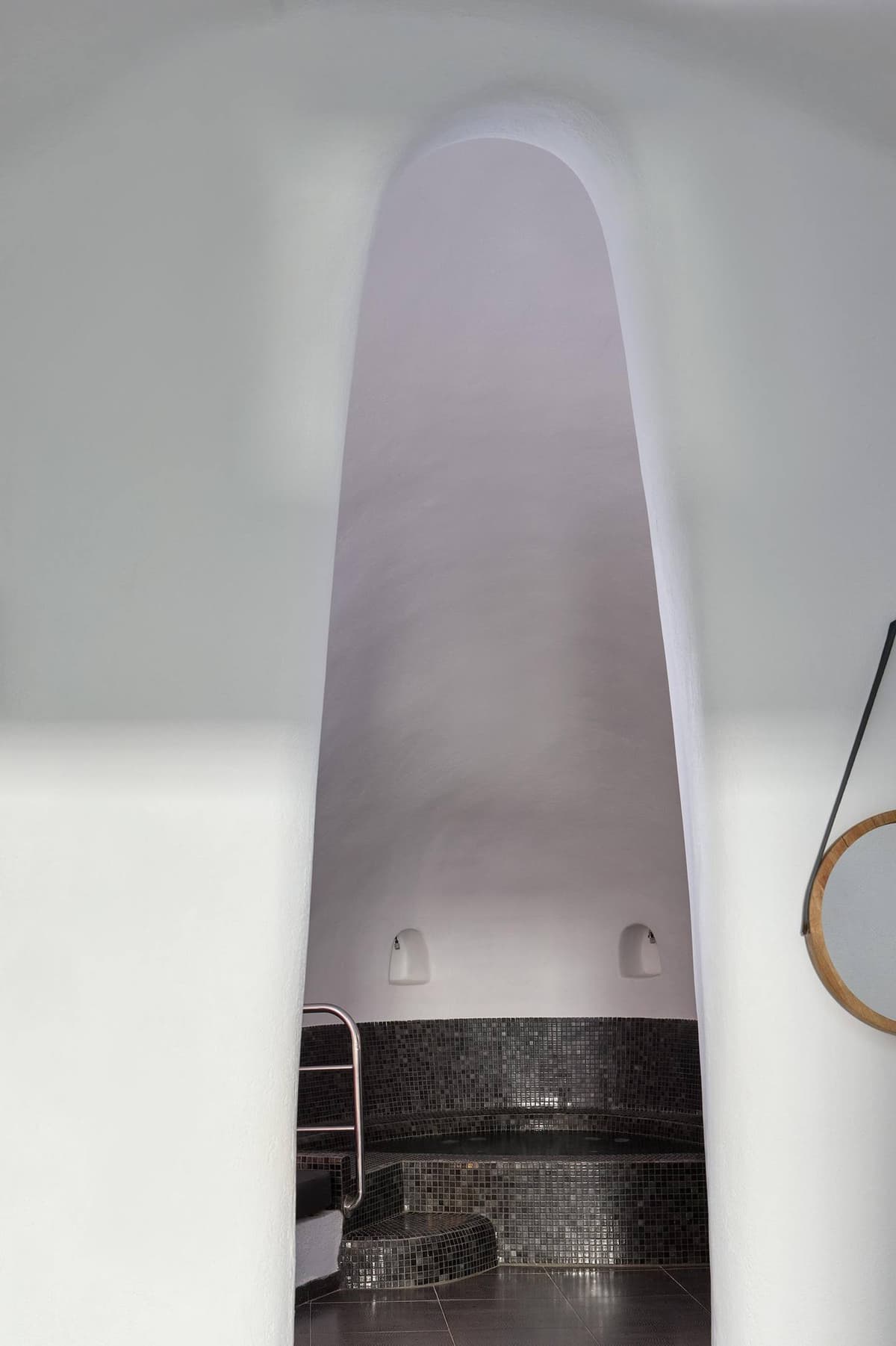
70m² cave suite with heated indoor jacuzzi and arched ceilings.
View room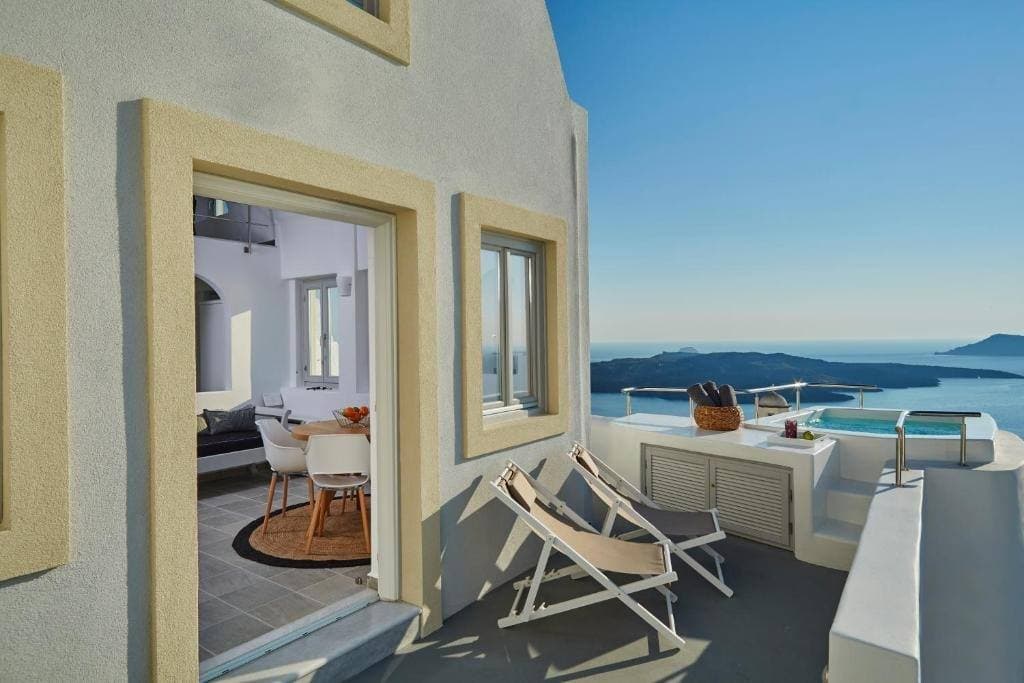
Heated outdoor jacuzzi on your own balcony, with the caldera and the sunset in front of you.
View roomYour Stay Awaits
Experience Santorini from a cave suite perched on the caldera edge in Fira.