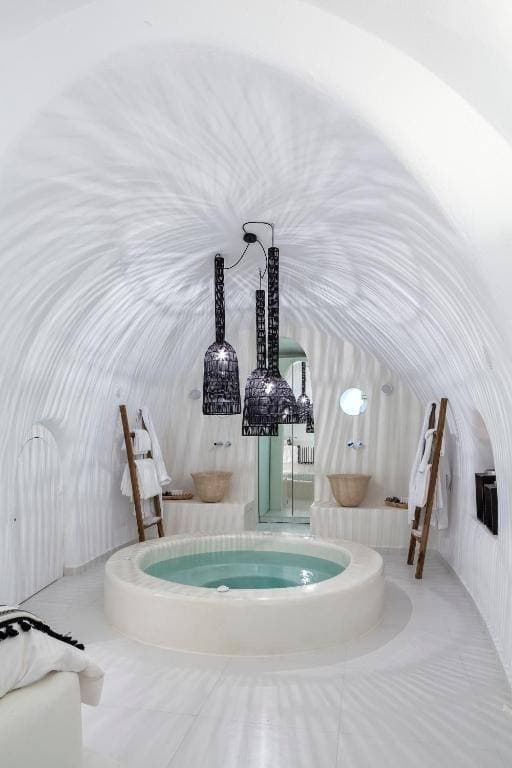
50m²
Honeymoon Suite
Cave suite with caldera-facing veranda, designed for couples and milestone trips.
View room
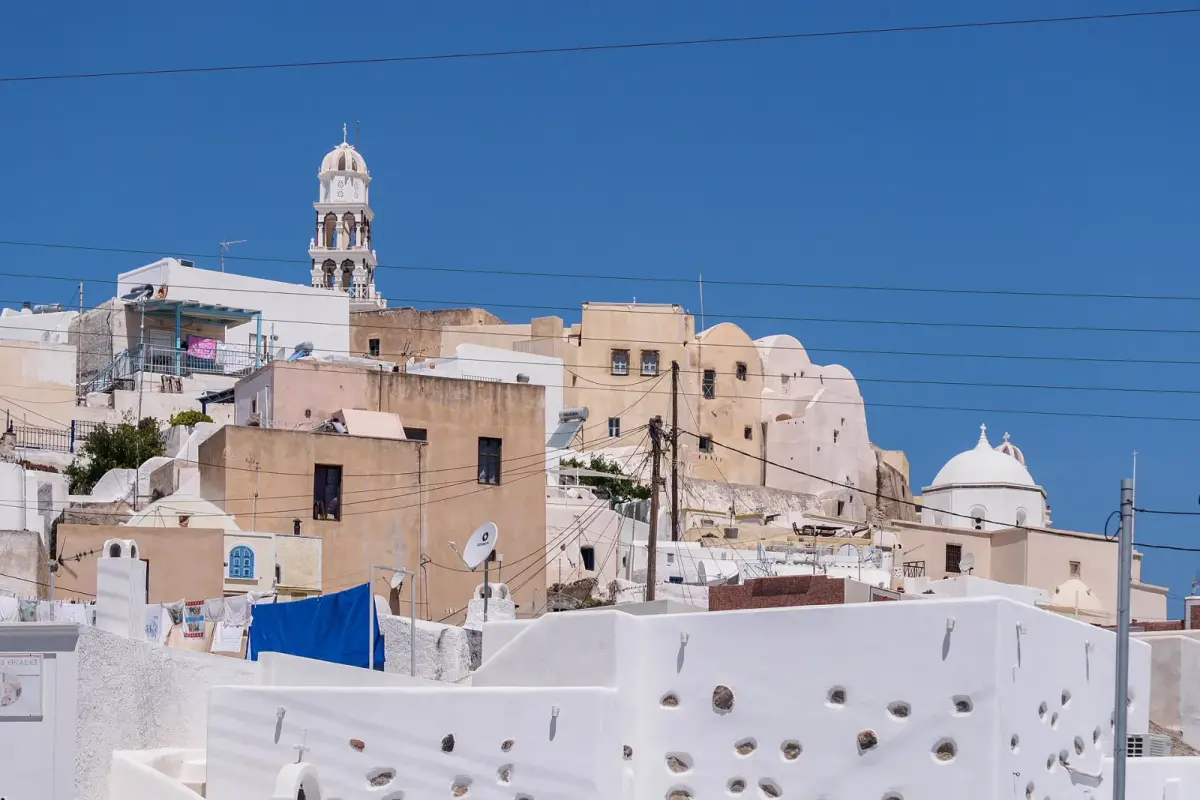
Villages
By Fanis Kafouros, Owner since 2006 · Published · Updated
Most visitors to Santorini never leave the caldera rim. But step inland, even a few kilometers, and the island becomes a completely different place. The tourists thin out. The architecture shifts from boutique hotels to crumbling towers and stone-walled alleys.
Short answer: Visit both on one half-day loop south of Fira. Emporio is a medieval fortress village built to keep pirates out, with alleys that twist and dead-end inside its kasteli. Megalochori is the wine village, full of canavas, cave wineries and bell towers, and it's the closer of the two. Neither has a beach, and only Megalochori's western edge looks out over the caldera, which is why they feel like the Santorini most visitors miss.
Most visitors to Santorini never leave the caldera rim. Fira, Oia, Imerovigli, Firostefani, the western cliff villages get all the attention because they get the sunset. But step inland, even a few kilometers, and the island becomes a completely different place. The tourists thin out. The architecture shifts from boutique hotels to crumbling towers and stone-walled alleys. The pace drops to something closer to a rural Greek village than an international holiday destination.
Emporio and Megalochori are the best examples of this. They sit on the southern half of the island (you can spot them on our Santorini map), about 11 to 14 kilometers from Fira by road (Megalochori is the closer of the two, Emporio a little further), a 15 to 20 minute drive south. And they share almost nothing in common with the caldera villages except the same volcanic rock underfoot. Emporio is a medieval fortress built to stop pirates. Megalochori is a wine village full of canavas, cave wineries, and bell towers. Together, they make a half-day trip that shows you a side of Santorini most people never know exists.
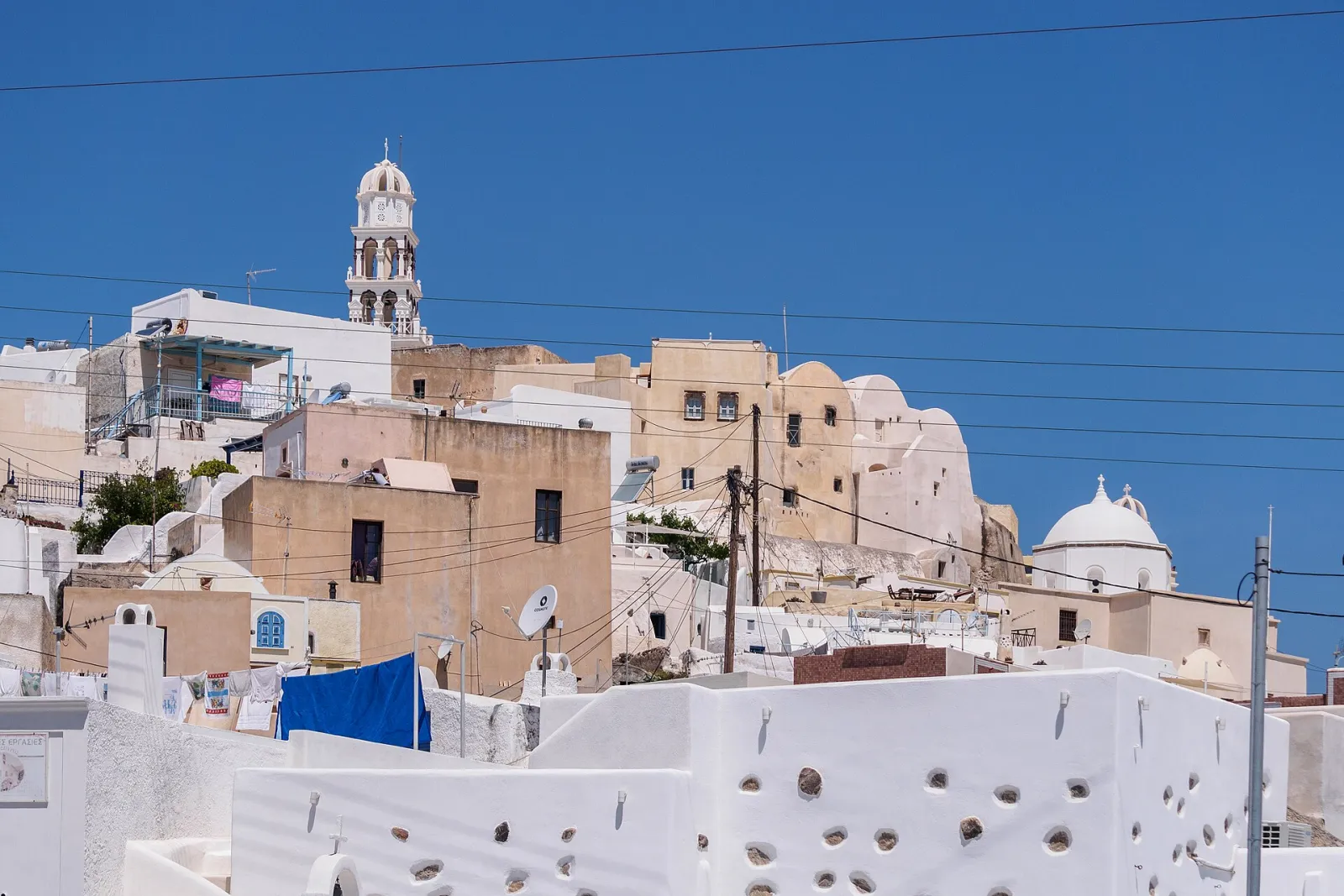 Photo: C messier, CC BY-SA 4.0, via Wikimedia Commons
This guide, part of our Santorini villages series, covers both in a single article because that's how they're best visited: together, in one morning or afternoon loop. What's worth seeing, where to eat, how to get there from Fira, photography spots, and an honest assessment of how much time each village actually deserves.
Emporio is the largest village on Santorini by population. You'd never guess it from the old center. The modern part has spread outward with newer houses and commercial buildings that look like any Greek town. But the original heart is the kasteli, a medieval fortified settlement that remains one of the best-preserved examples of defensive architecture in the Cyclades.
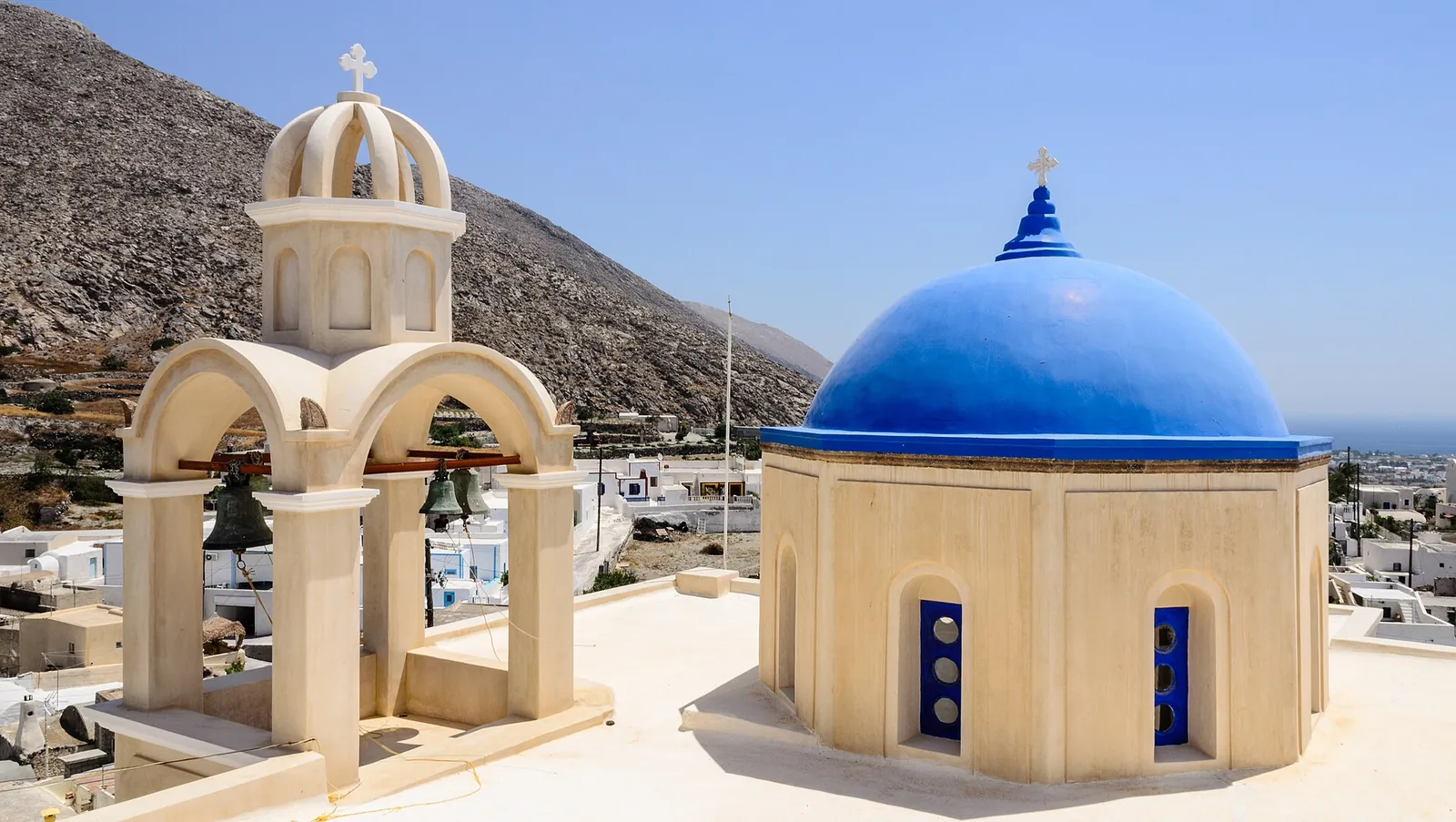 Photo: Norbert Nagel, CC BY-SA 3.0, via Wikimedia Commons
The word comes from Latin, castellum. And that's exactly what this is. A castle made of houses.
During the centuries when pirate raids were constant across the Aegean, Santorini's villages were built as defensive structures, not open settlements. Pyrgos had a similar kasteli higher up the mountain, but Emporio's is better preserved. The most intact surviving example on the island.
From outside, it doesn't look like much. A cluster of whitewashed walls, no obvious entrance. That's the point. The outer ring of houses forms a continuous wall, no windows facing out, no ground-level doors on the exterior. One single fortified gate. Seal it during an attack and the village becomes a fortress. Inside, the houses connect through tunnels, internal staircases, and alleys so narrow two people can't walk side by side. The layout was designed to confuse raiders even if they broke through.
Walking through the kasteli today is disorienting in the best way. Alleys twist and dead-end without warning. You pass through covered archways, duck under low doorways, emerge into sudden tiny squares that feel like stumbling into someone's private courtyard. Full sun to near-darkness and back in a few steps. Even in August you might see only three other people in here.
The Goulas is the tallest structure in the kasteli, a Venetian-era watchtower standing above the surrounding rooftops. It was the lookout point for spotting incoming ships, pirate or otherwise, and you can see it from most approaches to the village. The tower itself isn't open, but the streets around its base offer the best elevated views of the rooftop pattern: a dense jumble of domed ceilings, flat terraces, and whitewashed chimneys. Photographs well from above.
At the center of the kasteli stands this small Greek Orthodox church, the community's spiritual heart inside the fortress walls. Its blue dome is visible from several internal alleys, so it works as a landmark when you're lost in the maze. It's usually open, and the painted ceiling is worth a quick look.
Emporio's kasteli is atmospheric. Historically fascinating. The architecture is unlike anything else on Santorini. But it's small. You can walk through the entire thing in 20-30 minutes. No museums. No organized tours. No visitor facilities inside. People still live here, and aside from a couple of cafes on the edges, there's nothing commercial.
That's part of the appeal. But it also means this isn't a full-day destination. Give it 30-45 minutes of walking and photographing, have a coffee in the square, then move on.
Megalochori sits about 2 kilometers northwest of Emporio, on a slight rise with distant caldera views. Where Emporio's identity is defense, Megalochori's identity is wine. The village grew around the production and trade of Santorini's volcanic wines. The evidence is everywhere: stone-walled canavas carved into volcanic rock, neoclassical merchant houses built with wine money, and a rhythm to the village that still feels agricultural rather than touristic.
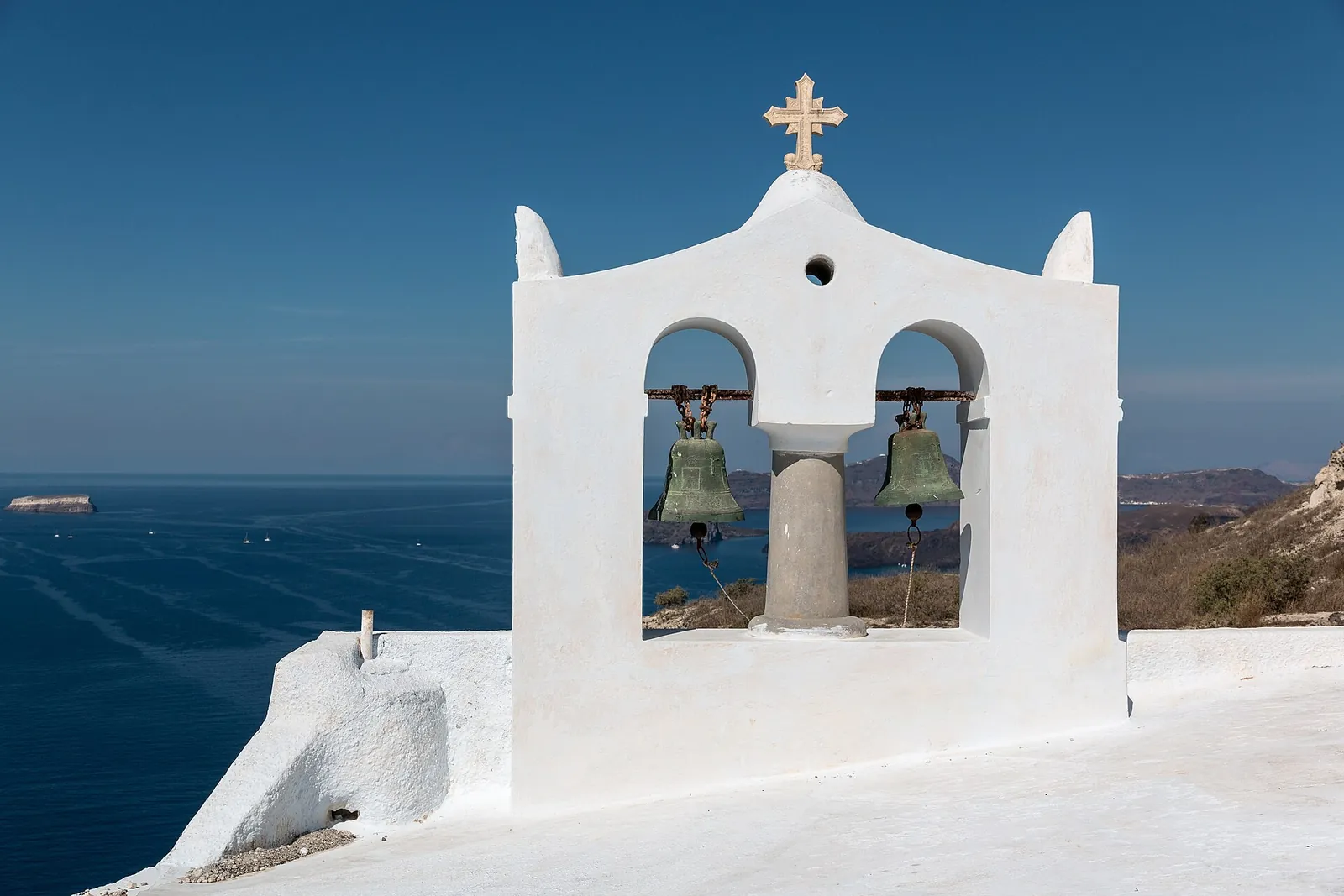 Photo: Dietmar Rabich, CC BY-SA 4.0, via Wikimedia Commons
Canavas are the traditional wine production caves of Santorini. Carved into the soft volcanic tuff, they maintained constant cool temperatures year-round, ideal for fermenting and storing wine before anyone had refrigeration. In Megalochori, you'll see several along the main streets, arched entrances set into stone walls. Some have become restaurants or small galleries. Others remain private.
The word canava comes from Italian, a reflection of centuries of Venetian influence. Inside, they feel far older than a modern wine cellar: rough-cut volcanic caves with low, dark ceilings and a musty mineral smell from centuries of wine soaking into porous rock.
Megalochori has some of the finest bell towers on the island. The Church of the Assumption (Kimisi tis Theotokou) in the central square has a distinctive tiered bell tower, appears in most guidebook photos of the village. Several other churches are scattered through the streets, each with its own tower or dome, giving the skyline a vertical quality you don't find in the flatter caldera villages.
The architecture mixes Cycladic white with neoclassical touches: painted wooden shutters, carved stone doorways, two-story mansions that belonged to wine merchant families. More decorative, more varied than the white-on-white of Fira or Oia. Some buildings show their age, with peeling plaster and sagging balconies, and that weathering is part of the village's charm.
The wine heritage isn't just historical. Working wineries operate in and around the village right now.
Gavalas Winery is the standout. One of the oldest family-run wineries on Santorini, with a winemaking heritage stretching back five generations and a history of crafting wines from the island's indigenous varieties. They work with grape varieties most visitors have never heard of: Katsano, Aidani Mavro, Voudomato. Small, unpretentious tasting room. Focused on wine, not views. Tastings run EUR 10-20 for three to seven wines, per Santorini Dave.
Boutari Winery sits on the main road just outside the village. Larger, more commercial and more polished than Gavalas, with a garden setting, well-organized tastings and a gift shop. If you want the full structured winery-visit experience with a guided tour, Boutari is the easier choice. If you want to talk directly with a winemaker about obscure indigenous grapes, Gavalas is the one.
For the bigger picture of the island's wine scene, see our Santorini wine tasting guide and our roundup of the best wineries in Santorini.
Megalochori's Easter celebrations are known across the island. Among the most traditional on Santorini. Good Friday: the epitaphios procession winds through narrow streets by candlelight. Easter Saturday at midnight: the Resurrection service fills the central square, and fireworks launched from the bell towers light up the village. Loud, chaotic, moving, if you happen to be on the island during Greek Orthodox Easter (a different date from Western Easter most years).
Planning a spring visit? Easter in Megalochori is one of the hidden gems of Santorini most travel guides miss entirely.
| Emporio | Megalochori | |
|---|---|---|
| Character | Medieval fortress, defensive architecture | Wine village, neoclassical mansions |
| Main attraction | Kasteli (fortified settlement) | Canavas, bell towers, wine heritage |
| Time needed | 30-45 minutes | 45-90 minutes (more with winery visit) |
| Restaurants | 2-3 casual tavernas | 4-5 restaurants, some upscale |
| Crowds | Almost none, even in summer | Light, mainly Greek visitors |
| Photography | Tight alleys, dramatic light/shadow | Bell towers, stone doorways, vine-covered walls |
| Wine options | None in village | Gavalas + Boutari wineries nearby |
| Distance from Fira | About 14 km (15-20 minute drive) | About 11 km (15-minute drive) |
| Bus from Fira | Yes (Fira-Perissa line) | Yes (Fira-Akrotiri line) |
| Best for | History, architecture, solitude | Wine, atmosphere, village dining |
KTEL Santorini runs buses from Fira's main station to both villages. Emporio: take the Fira-Perissa bus (roughly hourly in summer). Megalochori: take the Fira-Akrotiri bus, which stops at the village roughly hourly from 08:30 to 20:00 in summer. Check the KTEL Santorini schedule for current times.
Both villages, 15-minute drive from Fira on well-marked roads. Parking is easy at both. Neither draws enough tourists for parking to be a problem. From our cave suites in Fira, it's a direct route south through Mesaria.
There's no published fare for these villages. For comparison, a daytime taxi from Fira runs EUR 15-20 to Kamari and EUR 20-30 to Akrotiri, so expect something in between, and agree the price before you get in. In peak season, waits at the Fira taxi stand can stretch to 30-45 minutes. Book through your hotel if possible.
Here's how to visit both in a single half-day trip. Works best in the morning before the heat peaks.
9:00am - Drive or bus from Fira to Emporio (15 minutes)
9:15-10:00am - Walk through the kasteli. Find the main gate, the Goulas Tower, Panagia Mesani church. Photograph the rooftop pattern from the elevated streets.
10:00-10:30am - Coffee in the main square. Two cafes with tables under plane trees.
10:30am - Drive to Megalochori (5 minutes by car, or 20 on foot through vineyards)
10:45-11:30am - Walk Megalochori's streets. Central square, canavas, bell towers, residential lanes.
11:30am-12:30pm - Wine tasting at Gavalas or Boutari
12:30-1:30pm - Lunch in the village (see below)
1:30pm - Back to Fira, or continue south to Akrotiri or the Red Beach
Restaurant options inside Emporio are limited.
Most people eat in Megalochori after visiting Emporio. The village does have a couple of tavernas serving standard Greek fare, grilled meats, salads, mezedes, but they cater to locals and won't appear in any guidebook.
Better dining here. A couple of restaurants worth the trip on their own.
Raki is a small taverna on the village square, with grilled meats, salads and house wine from a local producer. Prices are reasonable by Santorini standards.
The resort restaurant at the luxury hotel on the village edge offers a more polished Mediterranean menu. Beautiful setting. Serious wine list. Five-star pricing. Worth it for a special dinner. Less so for a casual lunch between two village walks.
For more restaurant recommendations across the island, see our guide to the best restaurants in Fira and the full Santorini wine and food guide.
Emporio: All about light and shadow. Visit early morning (8-10am) when the sun sends shafts of light through gaps in the walls. Best shots: looking up through narrow passages toward sky. The Goulas Tower framed against blue. The rooftop pattern from elevated streets. The archways and covered passages create natural frames.
Megalochori: Texture and vertical elements. Visit late afternoon (5-7pm) for warm light on stone. Best shots: the central bell tower, canava arched entrances, weathered wooden doors, bougainvillea over stone. The color palette runs warmer here than the caldera villages, more sand-colored stone mixed in with the white.
For more locations across the island, check our Santorini photoshoot guide.
Both villages are at their best during shoulder season.
April-May and September-October: Comfortable temperatures. Greenery from winter rains, especially around Megalochori's vineyards. Almost no other visitors. You'll have both villages entirely to yourself most mornings.
June-August: Hot. Particularly inland where there's no sea breeze. Emporio's kasteli provides shade in the alleys, but Megalochori's open streets bake at midday. Visit before 10am or after 5pm.
Winter (November-March): Both villages are year-round communities. Not "closed." But restaurants may run reduced schedules and winery tasting hours can be limited. Check ahead.
For detailed seasonal planning, see our best time to visit Santorini guide and the full Santorini travel guide.
Emporio and Megalochori are not full-day destinations. They don't have the infrastructure, the attractions, or the scale for that. There are no sunset bars or infinity pools, and the caldera shows only from Megalochori's edge. These are small, quiet, partly agricultural villages where the most exciting thing on a given Tuesday might be someone herding goats through the square.
That is why they're worth your time. Walking through a fortress built to stop pirates, then sitting in a wine cave tasting grapes you've never heard of, feels like a reset, and a reminder that people have lived and worked on Santorini for thousands of years.
Give them a half day together, and expect something quiet and real.
Yes, if history and architecture interest you. The kasteli is one of the most unusual things you'll see on Santorini, a maze of pirate-proof alleys and connected houses with no equivalent on the caldera rim. Budget 30-45 minutes. It pairs well with Megalochori, just 5 minutes away by car.
Wine. The village grew as a wine-producing settlement, and its traditional canavas, cave wineries carved into volcanic rock, are still visible throughout the streets. Also known for neoclassical architecture, bell towers, and elaborate Greek Orthodox Easter celebrations. Gavalas Winery and Boutari Winery both operate near the village.
About 14 kilometers by road. Roughly 15-20 minutes by car or bus. The KTEL bus from Fira to Perissa stops in Emporio. You can also drive or take a taxi. There's no published taxi fare for Emporio; for comparison, Fira to Kamari runs EUR 15-20 and Fira to Akrotiri EUR 20-30, so agree the price before you get in.
Depends what you're looking for. Caldera views and sunsets: Oia is the most famous. Cliff-edge quiet: Imerovigli. Walkability and nightlife: Fira. Authenticity and a sense of what Santorini was before the tourists came: Emporio and Megalochori are the strongest candidates. For the full village comparison, see our Santorini villages guide.
Part of the Church of the Assumption (Kimisi tis Theotokou) in Megalochori's central square. Visible from most approaches to the village. The main landmark. Several smaller churches in the village also have distinctive bell towers.
Yes. About 2 kilometers on the road between them. Roughly 20-25 minutes through vineyard-lined countryside. No dedicated pedestrian path, so you walk the roadside. Pleasant in shoulder season. In summer heat, the 5-minute drive makes more sense.
Both Emporio and Megalochori make a perfect morning or afternoon trip from Fira. Explore fortress alleys and wine caves all morning, then head back to the caldera for sunset from your own balcony. Staying at Aroma Suites? Reception can arrange a wine tour with transport, or a rental car or ATV for the loop. Check availability and book direct.
Planning a Santorini trip?
Get our insider guide
Local tips, hidden spots, and an exclusive direct booking discount delivered to your inbox.
Stay with us
Six rooms and a private villa on the caldera in central Fira. Direct booking includes complimentary wine on 3+ night stays and free airport transfer on 4+ nights.
Cave suite with caldera-facing veranda, designed for couples and milestone trips.
View room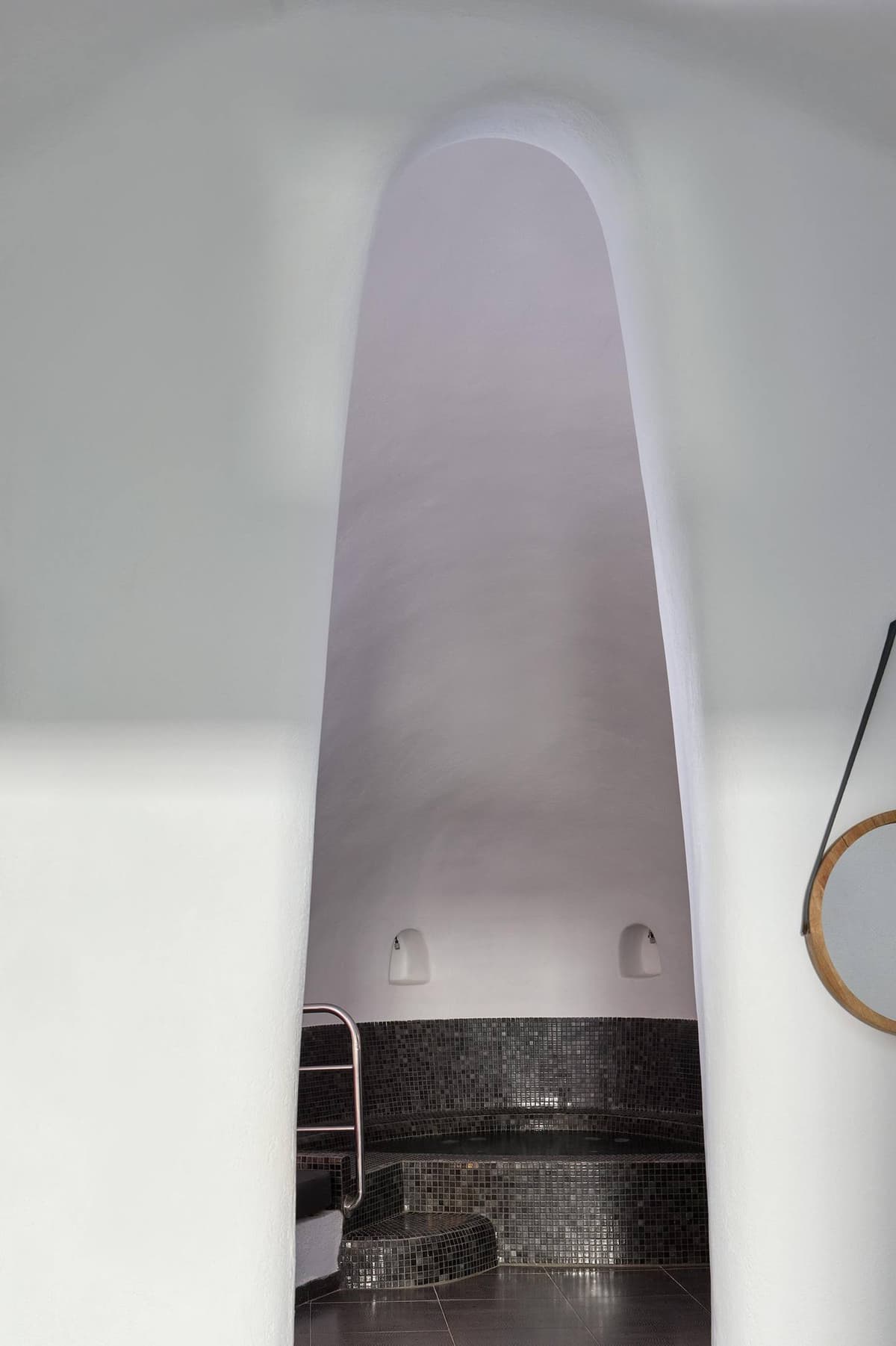
70m² cave suite with heated indoor jacuzzi and arched ceilings.
View room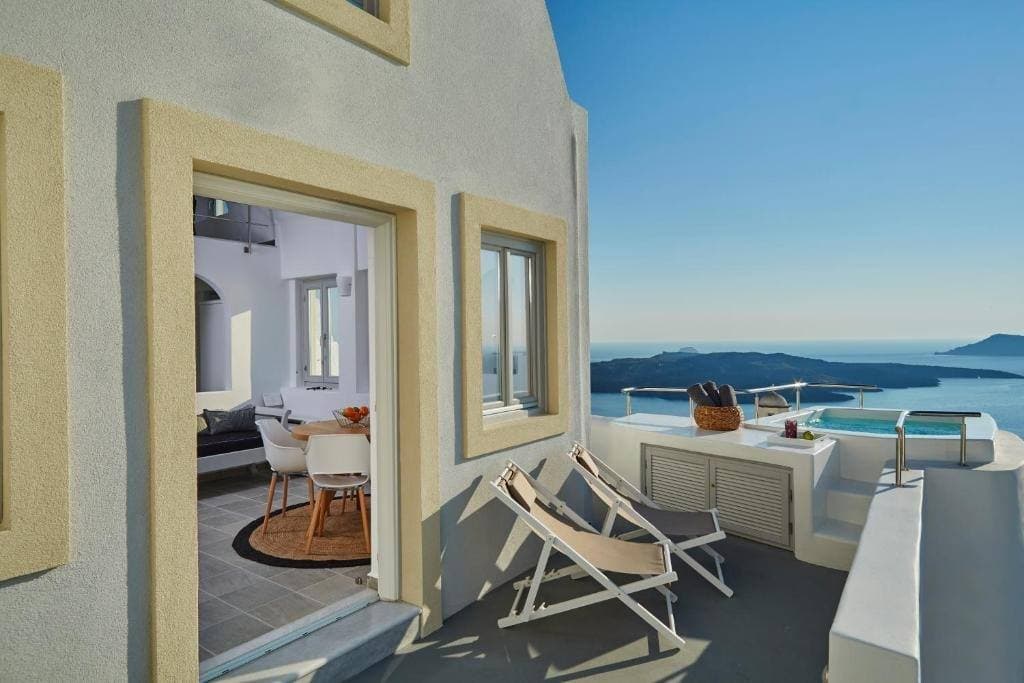
Heated outdoor jacuzzi on your own balcony, with the caldera and the sunset in front of you.
View roomYour Stay Awaits
Experience Santorini from a cave suite perched on the caldera edge in Fira.